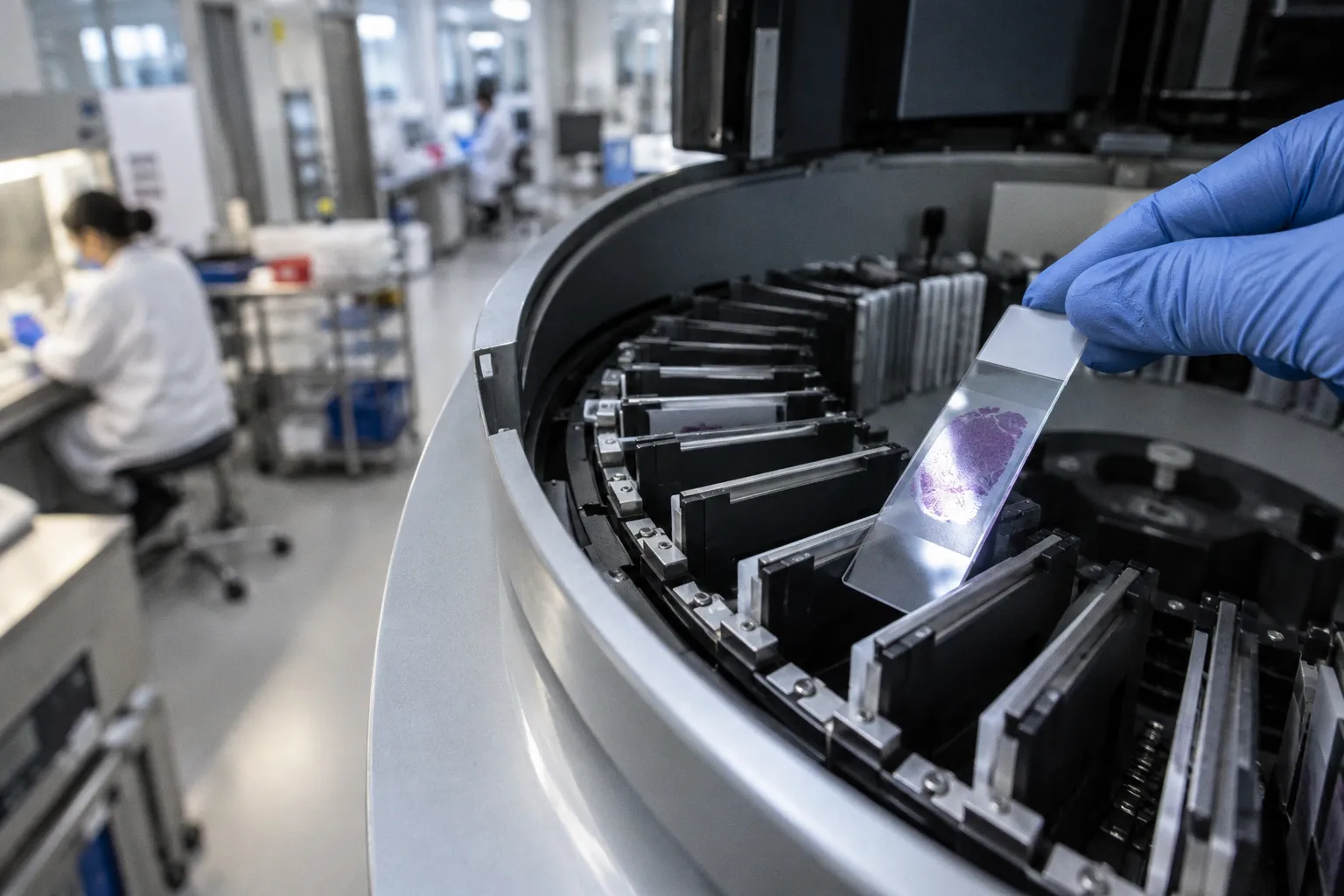
The cytology specimen preparation slides segment is entering a decade of structural acceleration, driven by parallel pressures in oncology screening volumes and the migration of pathology workflows toward digital platforms, according to a market outlook published by IndexBox. The convergence is no longer theoretical: within the same news cycle, the FDA cleared an Investigational Device Exemption for a pivotal study of Evident, an ovarian cancer screening test reported by Contemporary OB/GYN — a regulatory signal that directly influences upstream specimen demand in cytology laboratories.
Market trajectory through 2035
The IndexBox analysis frames cytology specimen preparation slides as a backbone consumable within a shifting diagnostic ecosystem, rather than a static lab commodity. Rising throughput from population-scale cancer screening — cervical, and increasingly ovarian — feeds directly into slide preparation volume, while digital pathology adoption reshapes the specifications that slides must meet. Calibration consistency, surface chemistry, and pre-analytical reproducibility are transitioning from quality-control footnotes to procurement-level criteria, as whole-slide imaging systems demand tighter tolerances than legacy light microscopy workflows.
Regulatory momentum in ovarian screening
The FDA's IDE approval for the Evident pivotal study, as reported by Contemporary OB/GYN, illustrates how screening policy translates into specimen logistics. Ovarian cancer has historically lacked an effective population-level screen; a validated assay would restructure referral pathways and, by extension, the volume and complexity of cytology specimens flowing through diagnostic laboratories. For molecular and anatomic pathology operations, the implication is twofold: capacity planning for slide preparation must anticipate expanded screening cohorts, and validation protocols for any ovarian-specific cytology workflow will need parallel alignment to the imaging and biomarker platforms used downstream.
What to monitor next
Three variables will determine whether current market projections hold. First, enrollment cadence and interim readouts from the Evident pivotal study — any acceleration or delay reshapes demand modeling for ovarian screening reagents. Second, reimbursement decisions from CMS and major commercial payers, which historically gate the diffusion of new screening assays into routine gynecologic practice. Third, the pace at which reference laboratories complete digital validation for cytology subspecialties, a prerequisite before expanded screening volumes can be absorbed without compromising turnaround times. The decade ahead will be defined less by incremental volume growth than by the operational rigor laboratories bring to a more demanding, more digital specimen pipeline.