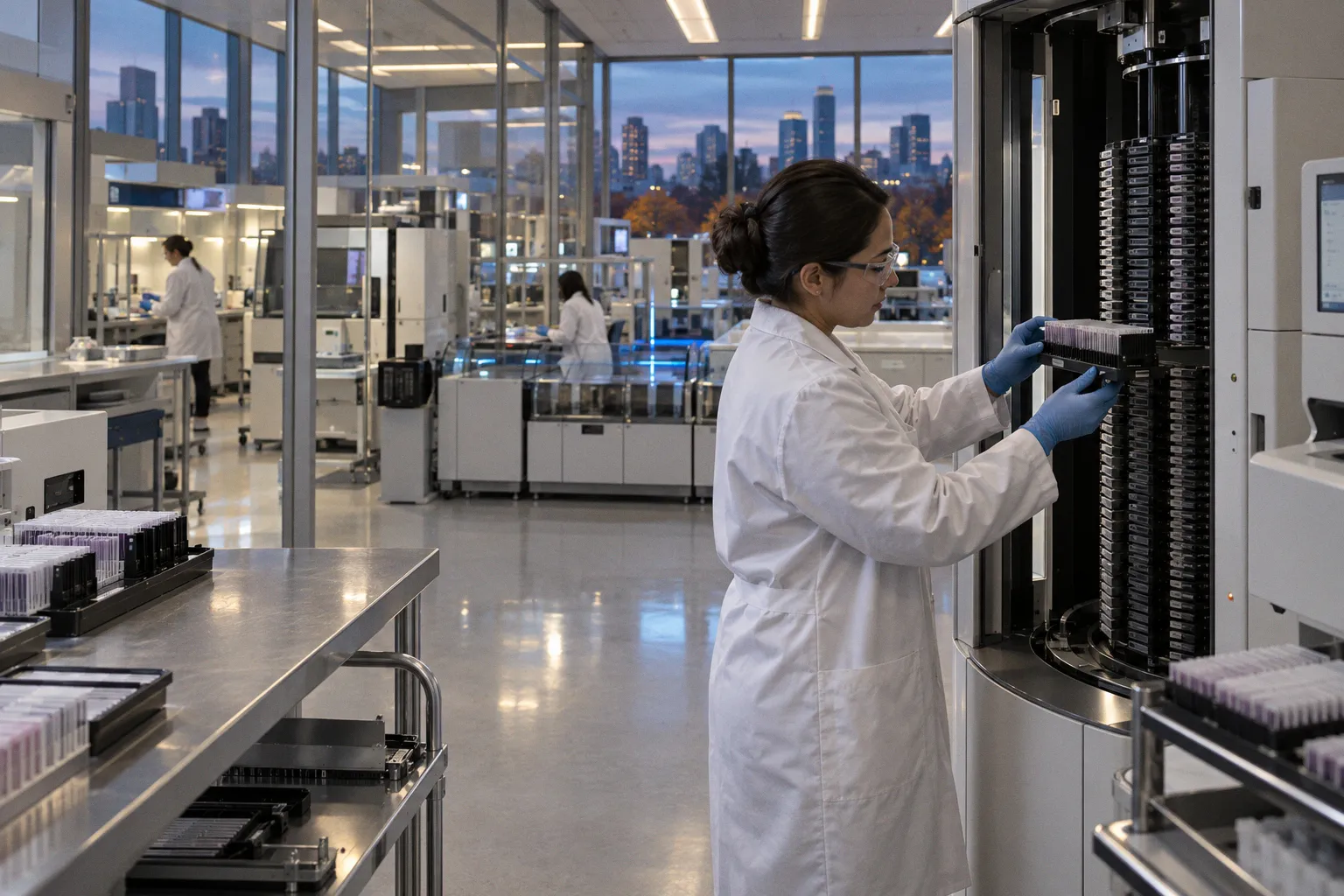
In molecular diagnostics, the exposure is higher because specimens are often transferred between collection sites, hospital laboratories, reference laboratories, couriers, accessioning teams, extraction benches, sequencing workflows, storage locations, and disposal streams. Every handoff creates an opportunity for misidentification, delay, contamination, incomplete documentation, or loss of accountability.
Specimen chain of custody protocols in molecular labs must therefore be treated as a controlled business process. The objective is not simply to locate a tube. The objective is to prove, at every stage, who had the specimen, when they had it, what action was taken, and whether the specimen remained fit for testing.
That evidence is the operational foundation of diagnostic integrity.
The preanalytical crisis is an operations failure
The preanalytical phase begins with test ordering and ends when the specimen reaches the analyzer. It includes patient and test identification, collection, labeling, packaging, transport, receipt, accessioning, preparation, and any decision to accept, reject, or recollect the sample.
This phase carries the highest concentration of avoidable risk. A molecular laboratory can have a validated assay, qualified personnel, and compliant instrumentation, yet still produce an unreliable result if the wrong specimen enters the workflow or if the correct specimen arrives compromised.
The financial consequences are equally direct:
- Recollection consumes phlebotomy, nursing, courier, accessioning, and laboratory labor.
- Rejected specimens create repeat contacts and additional administrative work.
- Delayed specimens reduce instrument utilization and disrupt batching.
- Misidentified specimens create investigation, correction, and reporting exposure.
- Untraceable transfers weaken the laboratory’s position during an audit or incident review.
- Poor sample visibility creates avoidable calls between the laboratory, clinical departments, and reference providers.
A laboratory director should not view these events as isolated clerical defects. They are throughput defects. They consume capacity without producing reportable results.
The correct response is not to add another reminder email. It is to build a chain of custody that controls the specimen lifecycle by design.
The laboratory cannot control diagnostic quality at the analyzer if it has lost control of the specimen before accessioning.
The eight-stage specimen lifecycle
A complete clinical specimen chain of custody covers eight distinct stages:
1. Collection
2. Labeling
3. Transportation
4. Reception
5. Processing and analysis
6. Storage
7. Retrieval
8. Disposal
Each stage requires a defined transaction, a responsible role, and a record that can be reconciled with the LIS. A chain of custody record that captures only collection and final reporting is incomplete. It does not explain what happened in between.
1. Collection
Collection begins with the test order. The order must identify the patient, requested assay or panel, source or specimen type where relevant, ordering location, and any information required for downstream processing.
Molecular pathology creates particular exposure at this point because specimen suitability can depend on source, fixation, tumor content, collection medium, volume, and time-sensitive handling. The laboratory does not need to turn every collector into a molecular technologist. It does need to make collection requirements operationally clear.
The collection workflow should establish:
- Which patient and order are being matched.
- Which specimen type is acceptable for the requested test.
- Which container or transport medium is required.
- What labeling must occur at the point of collection.
- What information must accompany the specimen.
- How exceptions are documented before transport.
The specimen should not enter the transport stream with unresolved identity or order ambiguity. Moving an uncertain specimen faster does not reduce risk. It accelerates the wrong process.
2. Labeling
Labeling is the first physical link between the patient record and the specimen. Molecular diagnostic sample tracking depends on that link remaining unique and readable through every subsequent workflow.
A robust labeling process uses machine-readable identifiers and minimizes manual transcription. Two-dimensional barcodes can connect the physical specimen to the LIS order record. Passive RFID can add location and movement visibility while carrying a non-PHI key rather than patient information directly on the tag.
The technology does not replace verification. It supports it.
At minimum, the laboratory needs controls for:
- Matching the specimen label to the order and patient demographics.
- Confirming that the label is attached to the correct container.
- Detecting duplicate, unreadable, incomplete, or conflicting identifiers.
- Preventing relabeling outside an approved correction process.
- Recording the identity of the person who resolves an exception.
A barcode that scans successfully is not proof that the specimen is correct. It is proof only that the system recognized the encoded identifier. Identity control still depends on the collection and accessioning procedures around that scan.
3. Transportation
Transportation is where custody often becomes invisible. A specimen leaves one controlled area and enters a distributed network of couriers, pneumatic tube systems, collection sites, hospital departments, and external laboratories.
The transport record should show when the specimen left the sending location, who or what accepted it, where it was routed, and when it arrived. For referred testing, the record must extend across the sending and receiving laboratories. The sending laboratory remains responsible for being able to explain the transfer, even when the receiving laboratory performs the test.
Temperature, packaging, transit time, and handling requirements depend on the specimen and assay. The operational requirement is broader: the laboratory must define the conditions under which a specimen remains acceptable and must document deviations that may affect testing.
Do not confuse a courier scan with a full chain of custody. A courier scan establishes a movement event. It does not necessarily establish specimen condition, packaging integrity, order matching, or acceptance by the receiving laboratory.
4. Reception
Reception is the first formal control point inside the testing laboratory. This is where the laboratory decides whether the specimen is eligible to proceed.
CLIA compliance policies require documented accessioning SOPs that address specimen integrity, specimen type, completeness of patient demographics, and automated communication of specimen rejection so that timely recollection can occur.
That requirement has a practical implication: rejection cannot remain an informal judgment made at a bench. It must be a standardized, visible workflow.
The receiving process should capture:
- Arrival date and time.
- Sending location and transport route.
- Specimen identifier.
- Patient and order match.
- Specimen type and container.
- Condition on receipt.
- Required accompanying documentation.
- Acceptance, conditional acceptance, or rejection decision.
- Reason for rejection or qualification.
- Notification and recollection status where applicable.
An accessioning team should not be measured only on speed. Speed without reliable acceptance decisions pushes defects downstream, where correction costs more and may no longer be possible.
5. Processing and analysis
Processing includes accessioning, aliquoting, extraction, preparation, analysis, and any referral or sub-referral activity required to complete the test. Each transformation must preserve the relationship between the original specimen, derived aliquots, extracted material, libraries, slides, blocks, and result record.
This is where molecular workflows can become difficult to audit. A single original specimen may generate multiple derived materials, each moving through a different work area or instrument. If those relationships are tracked only through handwritten notes or local spreadsheets, the laboratory has created a reconciliation problem.
The LIS should support parent-child relationships between the original specimen and derived materials. Where the LIS cannot provide the necessary detail, the laboratory needs a controlled secondary record with defined ownership and reconciliation rules.
The central question is simple: can the laboratory reconstruct the path from the original specimen to the reported result without relying on memory?
If not, the workflow has a traceability gap.
6. Storage
Storage is not a passive stage. It is an active custody state.
Specimens and derived materials may be held pending analysis, repeat testing, confirmation, send-out, quality review, or retention requirements. The laboratory should know not only where the material is stored, but also which storage condition, container, position, and status apply.
A storage record should support:
- Location assignment.
- Date and time of placement.
- Material type.
- Access restrictions.
- Retrieval history.
- Return-to-storage confirmation.
- Disposal authorization when retention ends.
Freezers and storage rooms often become the weakest point in molecular diagnostic sample tracking because they are treated as inventory areas rather than diagnostic workflow components. That is a mistake. An unlocated block, tube, or nucleic acid extract can delay a case, force recollection, or prevent a defensible review of the reported result.
7. Retrieval
Retrieval must be authorized, recorded, and closed. The laboratory needs to know why the material was removed, who removed it, what testing or review occurred, and where it went afterward.
This matters when a specimen is needed for:
- Repeat analysis.
- Orthogonal confirmation.
- Additional molecular testing.
- Quality investigation.
- Proficiency or validation work.
- Referral to another laboratory.
- Clinician or patient-related review under applicable procedures.
A retrieval event that lacks a return or final disposition creates an open custody transaction. Open transactions accumulate quietly until an audit, discrepancy, or urgent clinical request exposes the gap.
8. Disposal
Disposal closes the lifecycle. It should be performed according to the laboratory’s retention policy, applicable accreditation requirements, biosafety procedures, and any active investigation or clinical need.
The disposal record should identify the material, authorization, date, responsible personnel, and method or controlled disposal event required by the laboratory’s procedures. Disposal should never be used to clear an unresolved discrepancy.
The chain is not complete because the specimen is gone. It is complete when the laboratory can demonstrate that the material was disposed of through an authorized process.
Regulatory expectations: CAP, CLIA, and ISO 15189
Regulatory and accreditation frameworks do not all use identical language or impose identical operational mechanisms. Laboratory leaders should avoid a common compliance error: treating a technology choice as if it were the requirement itself.
CLIA requires documented controls for specimen management, accessioning, quality, and communication of rejection. It does not explicitly mandate RFID tracking. RFID is one possible operational control. The compliance obligation is to maintain reliable specimen identity, handling, documentation, and quality processes.
CAP is particularly influential in molecular laboratories because its accreditation model includes discipline-specific checklists updated annually and peer inspections. That structure creates a more detailed operational review than a generic laboratory policy review.
For laboratories referring specimens for Next-Generation Sequencing, CAP molecular checklist requirement MOL.35845 specifies that tracking records must describe unambiguously when and how specimens and data are transferred between referring and recipient laboratories.
This requirement should be treated as a transfer-control problem, not a paperwork exercise. The laboratory needs a record that can answer:
- Which specimen was transferred?
- Which data accompanied it?
- When did the transfer occur?
- How did the transfer occur?
- Which laboratory accepted responsibility?
- Can the result be reconciled to the original order and specimen?
The standard becomes operational only when the LIS, referral workflow, courier process, and receiving-laboratory confirmation produce consistent evidence.
ISO 15189:2022 provides an international framework for medical laboratory quality and competence. Its specimen handling expectations should be translated into local procedures that employees can execute under normal workload conditions. A policy that depends on perfect attention during a staffing shortage is not a control. It is an aspiration.
A practical comparison
| Operational requirement | CLIA-oriented control | CAP-oriented control | ISO 15189-oriented control |
|---|---|---|---|
| Specimen identity | Documented accessioning and patient/order matching | Discipline-specific review of identification and handling practices | Controlled processes that preserve traceability and competence |
| Specimen acceptance | Defined integrity, specimen type, demographic, and rejection procedures | Inspection against applicable checklist requirements | Risk-based control of preanalytical processes |
| Referred testing | Records and procedures supporting specimen management | Explicit tracking of specimen and data transfers for NGS referrals under MOL.35845 | Traceability across activities performed inside and outside the laboratory |
| Technology | No specific requirement for RFID or another tracking technology | Technology may support checklist compliance but does not replace process control | Technology should support documented, controlled, and auditable workflows |
| Audit evidence | SOPs, records, corrective actions, and communication evidence | Peer-inspectable records tied to specialty requirements | Objective evidence of an effective quality management system |
The strongest laboratories do not maintain three disconnected compliance programs. They create one specimen-control architecture and map it to each applicable framework.
Digital traceability: barcodes, RFID, and LIS integration
Manual documentation fails at scale because it depends on repeated human transcription. Molecular laboratories often handle multiple specimen types, high-value tests, distributed referrals, and derived materials. The greater the number of transactions, the less defensible a paper-only workflow becomes.
A digital tracking design should connect four layers:
1. Physical identity
The specimen, container, aliquot, block, slide, extract, or library carries a machine-readable identifier.
2. Order identity
The identifier links to the correct LIS order, patient record, requested assay, and specimen metadata.
3. Location and movement
Scans, RFID reads, or controlled user transactions record where the material is and when it moved.
4. Action and status
The system records acceptance, rejection, processing, storage, retrieval, referral, result association, and disposal.
Barcodes are usually the primary identity mechanism because they are inexpensive, familiar, and compatible with common laboratory workflows. Passive RFID can add automated presence or movement detection, especially where repeated scanning creates friction or where freezer and storage visibility is poor.
The architecture must protect patient privacy. A passive RFID tag should carry a non-PHI key linked to the LIS order record rather than exposing patient information in the physical environment.
The LIS must govern the exception path
Automation is valuable only when it stops bad work. A system that scans every specimen but allows staff to override every mismatch without a structured reason code is not controlling risk. It is creating a faster way to obscure it.
The LIS should force or strongly guide the following decisions:
- Accept the specimen.
- Reject the specimen.
- Place the specimen on hold.
- Request clarification.
- Request recollection.
- Refer the specimen.
- Reconcile a transfer.
- Record a controlled correction.
Each exception should have an owner, a timestamp, and a closure state. The laboratory should be able to report not just how many specimens were rejected, but why, by sending location, specimen type, service line, collection shift, and ordering environment.
That information has immediate management value. If one hospital unit repeatedly submits mislabeled molecular specimens, the response should target that unit’s process. Broad retraining across the entire network is expensive and usually less effective.
Avoid technology without workflow ownership
A tracking platform can fail for reasons that have nothing to do with scanning performance. Common causes include:
- No owner for unresolved alerts.
- Duplicate identifiers across connected systems.
- Manual workarounds during downtime.
- Inconsistent naming of specimen types.
- No reconciliation between referral and receiving laboratories.
- RFID or barcode deployment limited to one department.
- Storage events excluded from the LIS workflow.
- Staff trained on the tool but not on the control objective.
Technology deployment should begin with the custody events that create the greatest operational exposure. The laboratory does not need to digitize every movement on day one. It does need to eliminate blind spots at collection, receipt, referral, derived-material creation, and storage retrieval.
Standardizing accessioning and rejection policies
Accessioning is where the laboratory converts a physical object into a controlled diagnostic case. It is also where weak laboratories quietly accept ambiguity.
An accessioning SOP should define the minimum information required before testing begins. It should describe the decision path for incomplete demographics, mismatched identifiers, damaged containers, unsuitable specimen types, insufficient volume, missing clinical information, and compromised transport conditions.
The policy must also define who has authority to resolve each defect. A front-line accessioning employee should not improvise a patient identity correction. A molecular technologist should not silently change the specimen type because the test appears technically possible. A referral coordinator should not close a transfer because the courier system shows delivery.
The process needs escalation rules.
The acceptance decision should be explicit
A practical acceptance model has three states:
- Accepted: The specimen meets identification, type, integrity, and documentation requirements.
- Held or conditionally accepted: Testing may proceed only under a documented exception, with appropriate review and notation.
- Rejected: The specimen cannot proceed under the applicable procedure and requires notification or recollection.
The exact labels may differ by LIS. The principle should not.
A specimen should not remain in an ambiguous middle state while work continues around it. Ambiguity damages reporting timelines and makes later review difficult.
Rejection is a quality signal, not a performance failure
Some organizations suppress rejection data because they fear that higher rejection counts will make a department look inefficient. That incentive is backwards.
A low rejection rate can indicate good collection practice. It can also indicate that the laboratory is accepting defective specimens without documenting the risk. Management needs to distinguish those outcomes.
Rejection and exception data should be analyzed for patterns such as:
- Repeated defects from a particular collection site.
- Errors concentrated on a specific shift.
- Specimen-type confusion after a new test launch.
- Transport damage associated with one route or packaging method.
- Incomplete demographics from a particular ordering system.
- Delayed recollection after automated rejection notification.
- Repeated manual overrides by the same work area.
The objective is not to punish the accessioning team. It is to move defect prevention upstream, where it costs less.
Build the recollection loop
A rejection process is incomplete if it ends with a notification. The laboratory should know whether recollection was requested, whether the clinical team acknowledged it, whether a replacement specimen arrived, and whether the case was ultimately completed or canceled.
This is where specimen chain of custody intersects with service delivery and revenue cycle performance. An uncompleted molecular test may result in delayed treatment decisions, repeat administrative work, and lost or delayed billable activity. Those outcomes should not be treated as separate problems when they originate in the same preanalytical failure.
Managing referrals and NGS transfers
Next-Generation Sequencing workflows frequently cross organizational boundaries. A hospital may collect the specimen, a local laboratory may accession and prepare it, a reference laboratory may perform sequencing, and another entity may interpret or report the result.
Every transfer expands the chain. It also expands the number of systems that must agree.
The referral process should define:
- The point at which custody leaves the referring laboratory.
- The identifier used by both organizations.
- The data transferred with the specimen.
- The condition and status of the material at shipment.
- The method and timestamp of transfer.
- The receiving laboratory’s acceptance.
- The process for discrepancies or missing material.
- The return, retention, or disposal arrangement.
MOL.35845 is especially relevant because it addresses both specimens and data. A molecular workflow is not traceable if the physical tube can be located but the associated files, metadata, or transfer history cannot be reconciled.
Laboratory leaders should also separate clinical custody from forensic custody. Clinical chain of custody exists to support patient safety, assay accuracy, traceability, and regulatory compliance. It is not automatically identical to the legal requirements applied to forensic evidence.
That distinction matters because it keeps the laboratory focused on the controls that actually govern clinical diagnostic operations.
Metrics that belong in the management dashboard
A chain-of-custody program needs more than an SOP and an audit binder. Directors should monitor performance as an operational system.
Useful measures include:
- Specimen rejection rate by source and specimen type.
- Mismatch and relabeling events.
- Time from collection to receipt.
- Time from receipt to accession completion.
- Unresolved custody alerts.
- Referral transfer exceptions.
- Specimens with missing condition or temperature records where required.
- Retrievals not closed within the defined workflow.
- Storage materials not located on first search.
- Recollection completion rate after rejection.
- Manual override frequency.
- Downtime transactions requiring later reconciliation.
The dashboard should distinguish volume from failure. A large laboratory may generate more exceptions in absolute terms while performing better proportionally than a smaller site. At the same time, percentage metrics alone can hide high-impact events. A single patient identification failure may matter more than dozens of low-risk documentation defects.
Management should therefore review both trend data and serious-event data.
The strongest reporting question is not simply whether the laboratory met a target. It is whether the target reflects the actual risk of the workflow.
Implementation without creating another compliance project
A practical implementation sequence is straightforward.
First, map the actual workflow
Do not begin with vendor demonstrations. Follow a specimen from order to collection, transport, receipt, processing, storage, referral, retrieval, and disposal. Record every handoff and every manual transcription point.
The map should include what happens during:
- Normal operations.
- Urgent testing.
- Staff shortages.
- Instrument downtime.
- LIS downtime.
- Courier delays.
- Recollection requests.
- External referral.
- Corrective action investigations.
The difference between the written SOP and the workflow employees actually use is where the highest-value findings usually sit.
Second, identify the control points
Prioritize events that can cause patient misidentification, irreversible specimen loss, result misattribution, or major reporting delay. Do not spend the first implementation cycle optimizing low-risk storage scans while collection and accessioning remain dependent on handwritten labels.
Third, assign ownership
Every exception needs an accountable role. Ownership should cover:
- Alert review.
- Rejection communication.
- Recollection follow-up.
- Referral reconciliation.
- Storage discrepancy investigation.
- Downtime recovery.
- Corrective action.
- Policy review.
Shared responsibility without a named owner is usually no responsibility.
Fourth, integrate the systems
The LIS should be the authoritative record for order and specimen status. Tracking platforms, barcode systems, RFID readers, courier tools, and referral portals should exchange data through controlled interfaces or documented reconciliation procedures.
A fragmented technology stack creates fragmented accountability. The laboratory should know which system governs each event and how discrepancies are resolved.
Fifth, validate the process under pressure
A custody workflow that works only during quiet periods is not validated operationally. Test it with realistic exceptions: incomplete demographics, duplicate labels, rejected specimens, unreadable barcodes, delayed transfers, lost scans, storage retrievals, and downtime recovery.
The goal is not to prove that staff can follow an ideal procedure. The goal is to determine whether the system prevents unsafe progress when conditions are imperfect.
The margin depends on control before testing
Molecular laboratories often focus capital planning on analyzers, sequencers, extraction platforms, and automation. Those investments matter. But instrument capacity does not create value when the specimen feeding the workflow is delayed, unidentified, unsuitable, or impossible to reconcile.
Specimen chain of custody protocols in molecular labs are therefore part of the laboratory’s margin strategy. They protect throughput. They reduce avoidable labor. They support accreditation readiness. They strengthen referral relationships. They improve the probability that a completed analytical run produces a reportable, defensible result.
The right question is not whether the laboratory has a chain-of-custody policy. Most laboratories do.
The right question is whether the policy produces an unbroken, searchable record across all eight stages of the specimen lifecycle—and whether the organization can act on the exceptions before they become diagnostic failures.
A laboratory that cannot answer that question has a control gap. It should close it before the next audit, the next referral discrepancy, or the next high-consequence identification event forces the issue.