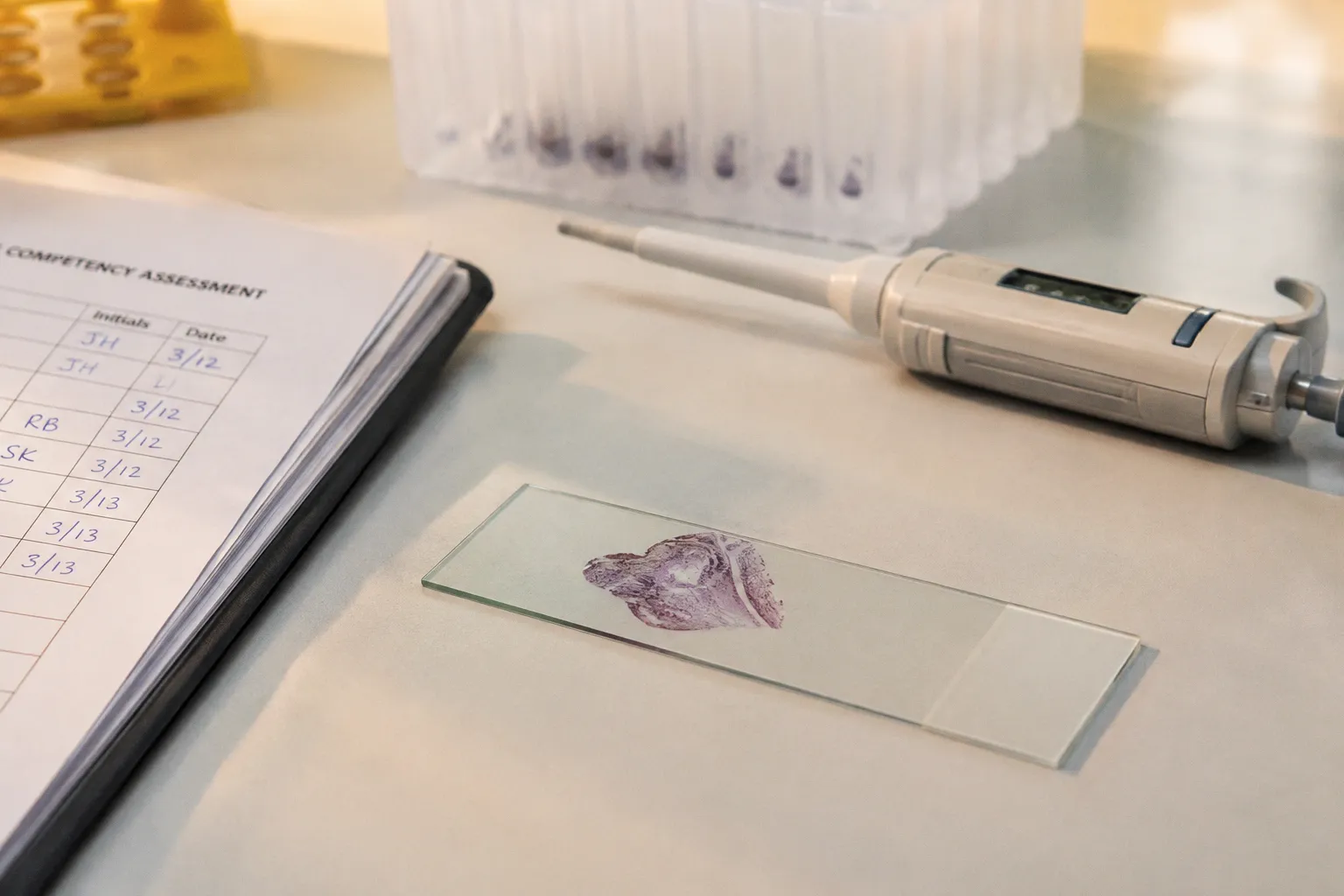
A tech you've known for years — steady hands, calm voice, has run the same blood culture workflow for what feels like a thousand shifts — pulls a positive bottle on a Friday afternoon. The Gram stain looks ambiguous. The reading is reasonable but not textbook. She calls it a possible gram-positive cocci in clusters. The result goes out. Two days later the organism grows, and it turns out to be something more nuanced that would have benefited from a slightly different stain prep or a closer second look at the smear. Nothing catastrophic. But the case stays with me because the question isn't whether this tech is competent. She is. The question is whether we have the documentation to prove it — under 42 CFR §493.1451, with all six elements, on the right cadence, signed by the right person.
That's the work. And in my conversations with lab managers across the country, it's the work that gets the most inconsistent treatment. Competency assessment under CLIA is one of the top cited deficiency categories during CAP and CMS inspections. It is also one of the most human processes in our regulatory framework, because it asks a supervisor to honestly evaluate a colleague's hands-on performance at the bench. Let me walk you through what the regulation actually requires, where labs most often slip, and how to build an assessment system that holds up to scrutiny without becoming a paperwork exercise.
Reading the Regulation Without Falling Asleep: 42 CFR §493.1451
The first thing to internalize is that competency assessment for high-complexity testing is not a recommendation buried in a guidance document. It lives in federal regulation — specifically 42 CFR §493.1451 — and it carries the force of CMS behind it. The language is direct: laboratories performing high-complexity testing must conduct documented competency assessments for all testing personnel. There is no "if applicable" carve-out for senior staff, no grandfathering based on tenure, and no exemption for techs who happen to have decades of experience.
The regulation also tells you what the assessment must contain: six specific elements. It tells you how often it must happen: semiannually during the first year of testing patient specimens, then annually thereafter. And it tells you who is qualified to perform the assessment: a Technical Supervisor, or a General Supervisor to whom that authority has been delegated. Those four anchors — six elements, six months, twelve months, qualified assessor — are the spine of the entire framework. If you understand them, the rest of the compliance picture starts to make sense.
What's often missed, in my experience on the bench and in conversations with working microbiologists, is how narrow the regulation is on what counts as competency. CLIA is uninterested in whether your tech is a good colleague, a fast worker, or a kind mentor to new hires. It is asking specifically: can this person, on this test, in this lab, produce reliable results on the days when the instrument throws a curveball and the specimen is less than textbook? Everything we build in competency assessment should answer that question.
The Six Mandatory Elements of Technical Competency
Here's where the work gets concrete. The six elements codified in §493.1451(b) are not interchangeable suggestions — each one addresses a different phase of the testing process, and inspectors want to see evidence of all six for every tech, every cycle.
Let me walk through them the way I'd explain them to a new supervisor:
1. Direct observation of routine test performance. This is the easiest one to picture. A qualified assessor stands next to the tech (or watches via a one-way mirror, or reviews a recorded procedure, depending on the test) while the tech performs the test on a patient specimen. The assessor is checking technique: pipetting, instrument operation, sample preparation, the small mechanical choices that determine whether a result is right or almost-right.
2. Monitoring the recording and reporting of test results. This one often surprises newer supervisors because it feels administrative. It isn't. The assessor is reviewing whether the tech is documenting results correctly — right units, right patient identifiers, right reporting channels, right interpretation when interpretation is part of the test. A tech who runs a perfect ELISA but transcribes the result to the wrong well on the worksheet has still failed this element.
3. Review of intermediate test results, quality control, proficiency testing, and maintenance records. This is the audit-trail element. Can the tech recognize a QC drift before it goes patient-side? Do they file PT samples correctly? Are they actually reviewing the maintenance log, or just signing it? A surprising number of competency findings live here.
4. Direct observation of instrument maintenance and function checks. This goes beyond reading the maintenance log. The assessor verifies that the tech can actually perform the maintenance correctly — that they know which reagent goes where, that they can troubleshoot a calibration failure, that they don't skip steps when they think no one is watching.
5. Evaluation of test performance through blind or previously analyzed samples. This is the part labs sometimes try to shortcut. The intent is to test the tech's interpretive judgment on samples whose answer is already known to the assessor but not to the tech. Replicate patient samples that have already been reported, PT samples presented as unknowns, or seeded materials all qualify. A quiz or a verbal walk-through does not satisfy this element, no matter how rigorous it feels.
6. Assessment of problem-solving skills. The final element is the most subjective and, in my view, the most important. What does the tech do when the instrument gives an unexpected flag? When the specimen is clotted, lipemic, or quantity-not-sufficient? When the result doesn't match the clinical picture? Competent techs ask the right questions in the right order. Techs who have picked up bad habits from a busy shift may force a result, ignore the flag, or escalate inconsistently.
The six elements are not a menu. Every tech, every assessment cycle, gets all six — or the documentation is incomplete.
Who Can Actually Sign the Form: Technical and General Supervisor Roles
This is where I see the most friction between regulatory theory and bench reality. The regulation is clear: for high-complexity testing, competency assessment must be performed by a qualified Technical Supervisor or by a General Supervisor to whom the Technical Supervisor has formally delegated the responsibility. A peer bench technologist cannot sign off on another tech's competency unless that peer holds General Supervisor qualifications under 42 CFR §493.1461.
The qualification pathway is also worth understanding, because labs sometimes assume that "senior tech" and "qualified General Supervisor" are the same thing. They aren't, at least not in the regulatory sense. General Supervisors must meet specific education and experience requirements codified in the federal regulations, and for those qualifying through the experience pathway, the original February 28, 1992 grandfather date still shapes who is eligible. If your senior tech doesn't meet those criteria — and many don't — they can mentor, they can observe informally, they can absolutely be part of the bench culture that supports good work, but they cannot be the signature on the competency form.
The practical implication is that labs need to identify, in writing, who their qualified assessors are for each test system, and ensure that delegation is documented when General Supervisors are used. This is not paperwork theater. Inspectors will ask, and a sloppy delegation chain is one of the fastest ways to convert a routine competency assessment into a deficiency citation.
The Cadence Question: Six Months, Then Twelve
The timing requirement is short enough to recite: semiannual assessment during the first year of testing patient specimens, then annual assessment every twelve months thereafter. The phrase "first year of testing patient specimens" matters more than it might seem at first read. The clock starts when the tech first performs patient testing under your lab's CLIA certificate, not when they were hired, not when they completed orientation, and not when their training checklist was signed.
For most labs, this translates into two formal competency assessments in the first year — at the six-month mark and at the twelve-month mark — before settling into an annual rhythm. For high-turnover benches or new test system rollouts, the first-year cadence is where most of the regulatory exposure lives, and it's also where most of the operational pain lives, because you're scheduling assessments twice as often for staff who are still settling in.
A few practical patterns I've seen work well: tie the six-month assessment to a calendar reminder at the same time each year (so the first-year and ongoing cycles align visually for the supervisor); build the assessment into a recurring quarterly compliance review rather than a once-a-year scramble; and treat the assessment form itself as a living document that carries forward between cycles, so you're not re-deriving the test plan from scratch every six months. None of these are regulatory requirements. All of them reduce the human error rate in scheduling, which is where most cadence-related findings actually originate.
Where Labs Most Often Slip: Competency Versus Everything Else
The final distinction I want to draw — and probably the one that saves the most labs from inspection trouble — is the difference between CLIA competency assessment and the other evaluations we do as managers. Initial training checklists do not satisfy competency. Annual HR performance reviews do not satisfy competency. A passing grade on a CE module or a vendor-provided certificate does not satisfy competency. Continuing education, while valuable and often required by other authorities, does not satisfy competency.
I bring this up because the line gets blurry in busy labs. When a tech completes training on a new instrument, there is a strong temptation to mark that training event as the competency assessment for the year. When HR sends around the annual review, there is a similar temptation to file the review in the competency folder. Neither of those documents contains the six elements, performed on the right cadence, signed by a qualified assessor. They may be useful supporting documentation. They are not the competency assessment.
If a CLIA surveyor asks for your competency records and you hand them an HR review, the conversation is already going sideways.
What I tell lab managers who are tightening up their program is this: build the competency assessment around the six elements, schedule it on the regulatory cadence, identify the qualified assessor in advance for each tech and each test system, and keep the documentation in a single, audit-ready location. Everything else — training records, HR reviews, CE certificates — lives alongside it, not in place of it.
The reason this matters, beyond avoiding citations, is that a well-built competency program is also one of the strongest patient-safety tools we have. The cases I think about most are the ones where a small drift — a calibration step skipped, a QC trend ignored, a flag forced through — could have been caught by a more rigorous assessment cycle. We won't catch every drift. But we can build a system that catches the ones that matter, on the cadence the regulation requires, signed by the people the regulation trusts. That's the work. And it's worth doing well.