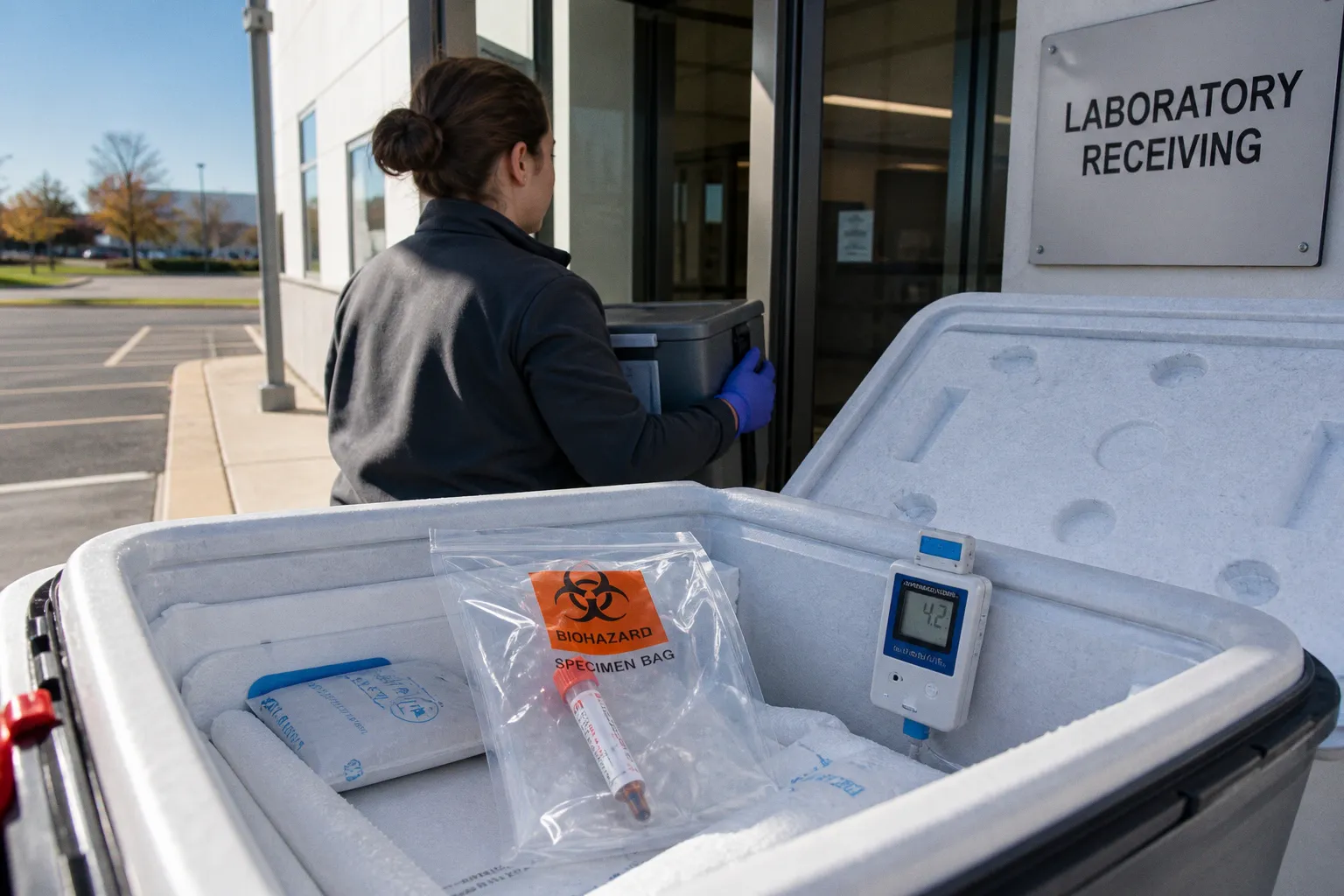
In molecular pathology, that interval is no longer a logistical margin but a clinical determinant: a single mislabeled aliquot, a delayed courier transfer, or a breached cold-chain window can convert a high-complexity biomarker assay into a stratification decision built on degraded input. The molecular pathology specimen chain of custody has accordingly migrated from a transport manifest into a regulated data discipline, where analytical validity is effectively decided before nucleic acid extraction.
For hospital laboratories and reference diagnostics networks that issue thousands of molecular results per week, the regulatory and operational question has narrowed. The challenge is no longer whether preanalytical variables compromise molecular fidelity — the evidence on that point is settled — but how rigorously chain-of-custody frameworks can be engineered to satisfy CLIA, CAP, and ISO 15189:2022 expectations without inflating turn-around-time. The trajectory that follows is one of progressive automation, middleware-driven surveillance, and ALCOA+-anchored traceability as the operating standard.
The Preanalytical Crisis: Where the Majority of Errors Are Seated
Clinical laboratories have long tracked a roughly stable distribution of error across the three testing phases. Published analyses consistently assign the preanalytical phase the dominant share — between 60% and 70% of total errors — while the analytical phase contributes a comparatively narrow band, and the post-analytical phase absorbs the remainder. The overall frequency of laboratory errors among total test results remains low, generally reported between 0.012% and 0.6%, but the asymmetry of distribution means that investment in analyzer precision alone produces diminishing diagnostic return. In molecular pathology, the asymmetry is intensified.
In molecular pathology, the specimen is the assay. Nucleic acid integrity, sample identity, and pre-extraction handling define the ceiling of analytical sensitivity that no downstream reagent chemistry can restore.
Molecular assays amplify nucleic acid targets to detect events that may exist at copy numbers well below 1,000 per milliliter of plasma or as fragmented single-nucleotide variants in formalin-fixed tissue. Each of these workflows carries preanalytical vulnerabilities that conventional chemistry platforms tolerate but molecular platforms do not. Cold ischemia time in surgical specimens directly governs DNA yield and the allele dropout rates that erode the efficacy of next-generation sequencing panels. RNA-based biomarker assays — including fusion transcript detection and gene-expression profiling — are particularly exposed to degradation during transport delays exceeding established stability windows. Specimen misidentification, historically a clerical risk in the accessioning bay, becomes a high-impact event when the downstream assay is a companion-diagnostic stratification result rather than a routine chemistry panel.
The categories of preanalytical failure most consequential in molecular workflows can be summarized as follows.
| Preanalytical Variable | Molecular Pathology Exposure | Operational Control Point |
|---|---|---|
| Specimen misidentification | False biomarker call; incorrect patient stratification | Two-identifier verification at collection and accessioning; barcode reconciliation |
| Transport delay / cold-chain breach | Nucleic acid degradation; failed RNA fusion detection | Time-stamped courier telemetry; validated stability envelopes per analyte |
| Cold ischemia (surgical tissue) | Allele dropout; FFPE-induced DNA fragmentation | Standardized ischemia ceiling; fixation protocol monitoring |
| Hemolysis / lipemia / icterus (plasma assays) | Inhibitor carryover into PCR; cfDNA dilution | Visual inspection criteria; hemolysis index thresholds |
| Aliquoting error / cross-contamination | False-positive PCR amplification; carryover | Unidirectional workflow; dedicated reagent preps |
The common thread is that none of these variables are visible on the analyzer. They are resolved or compounded before the run begins, which is why the preanalytical phase requires governance architecture rather than instrument calibration alone.
Applying ALCOA+ Principles to Molecular Specimen Traceability
The regulatory answer to preanalytical invisibility is traceability, and the most widely adopted traceability framework in regulated laboratory environments is the ALCOA+ specification. Originally codified in pharmaceutical and device good-practice guidance and now embedded into FDA, EMA, and ISO documentation expectations, ALCOA+ specifies that every data point — including the physical and electronic record of a specimen — must be Attributable, Legible, Contemporaneous, Original, and Accurate, with the + extensions of Complete, Consistent, Enduring, and Available.
In the molecular specimen chain of custody, ALCOA+ translates into a continuous audit trail that begins at the bedside or biopsy suite and terminates only when the result is released to the medical record. Each transition — collection, labeling, courier handoff, accessioning, centrifugation, aliquoting, extraction, plate loading — must be recorded against a unique specimen identifier, time-stamped at the moment of the event, and traceable to the operator and instrument that performed it. The legibility requirement now maps directly to barcode-driven or RFID-tagged specimen containers rather than handwritten labels, an operational shift that CLIA-accredited laboratories have largely completed for high-throughput molecular lines.
The practical bar for ALCOA+ compliance is straightforward in concept and demanding in execution. A reviewer reconstructing, from system records alone, the complete handling history of any specimen issued a result during the previous two years should be able to do so without gaps. Every handoff must leave an immutable trace: who collected, who labeled, when the courier received it, when accessioning logged it, which centrifuge processed it, who aliquoted it, and when the extraction plate was loaded. Where any link in that chain is missing, undocumented, or reconstructable only through informal recall, the laboratory has a preanalytical compliance gap regardless of analyzer performance.
The legal anchor for this electronic record continuity in the United States is 21 CFR Part 11, which governs electronic records and electronic signatures in regulated environments. For molecular laboratories operating under CLIA, the Part 11 expectations intersect with CAP checklist requirements on data integrity, particularly around audit trail immutability and access controls. The international counterpart is ISO 15189:2022, the most recent revision of the medical laboratory quality and competence standard, which expands the preanalytical chapter considerably and frames specimen reception and handling as a measurable competence domain rather than a procedural footnote.
ALCOA+ is not a documentation convention; it is the operational contract that converts a physical specimen into a legally defensible diagnostic event.
For laboratories evaluating whether their chain-of-custody systems meet ALCOA+, the practical assessment is whether the electronic infrastructure captures and preserves every transition in the specimen lifecycle — and whether that capture is automated and tamper-resistant rather than dependent on manual logging that staff may skip during high-volume surges.
Navigating CLIA and CAP Compliance for Sample Integrity
The American regulatory floor for clinical laboratory operations is set by CLIA, originally enacted in 1988, which establishes quality standards across hundreds of thousands of laboratory entities in the United States. CAP accreditation, while voluntary at the federal level, carries significant practical weight for laboratories seeking payer contracts, academic affiliations, or participation in reference networks. In many institutional contexts, accreditation is effectively expected rather than optional — though the degree to which it is required varies by region, payer mix, and institutional policy. For accredited laboratories, CAP operationalizes CLIA through its checklist system — a granular inspection instrument revised annually that addresses preanalytical controls in considerable detail.
For specimen integrity, the relevant CAP checklist requirement is COM.06300, which obliges laboratories to define and adhere to explicit specimen rejection criteria for samples failing established preanalytical parameters. The practical implication is that a laboratory cannot operate on a discretionary basis when an unlabeled tube or hemolyzed plasma arrives at accessioning; the laboratory must publish, validate, and apply rejection criteria that reference stability limits, container type, transport conditions, and identification completeness. Rejection must be documented, communicated to the ordering clinician, and recorded against the patient encounter — and a rejected specimen is itself a data point subject to ALCOA+ traceability.
The CLIA quality system regulations establish requirements for written procedures governing preanalytical processes, personnel competency assessments for collection and handling activities, and — where applicable — proficiency testing that addresses preanalytical performance. These requirements, codified in 42 CFR Part 493, create the regulatory baseline against which laboratories must demonstrate that specimen handling and preparation are controlled with the same rigor as analytical procedures. Laboratories subject to CMS survey work understand that preanalytical compliance is among the most frequently cited deficiency categories, particularly around stability documentation and the chain of handoff between courier and accessioning staff.
For molecular workflows, three regulatory touchpoints warrant particular attention.
1. Stability envelopes. Each analyte class — cell-free DNA, RNA, formalin-fixed tissue, fresh-frozen tissue, bone marrow aspirate — has a documented preanalytical stability envelope defining maximum transport time, temperature range, and acceptable delay before processing. The laboratory must validate these envelopes internally and reflect them in the test menu. For cell-free DNA in particular, the stability window may be as narrow as a few hours at ambient temperature, making transport logistics a first-order clinical variable.
2. Specimen rejection criteria. Rejection criteria must be written, accessible to phlebotomy and clinical staff, and applied consistently. Molecular assays compound the cost of inappropriate acceptance: a hemolyzed plasma sample run on a liquid biopsy assay can produce a false-negative EGFR result with direct therapeutic consequence. The laboratory's responsibility is to reject at accessioning, document the rejection, and offer a recollection pathway — not to silently proceed with compromised material.
3. Documentation continuity. From collection to result release, each handoff must be recorded under ALCOA+ and retained for the regulatory minimum — typically two years for clinical records, longer for molecular assays with companion-diagnostic implications.
The operational pressure on laboratories is that compliance cannot be delegated to a single platform. CLIA and CAP are satisfied through a combination of procedural discipline, middleware logic, and audit-grade record-keeping — none of which a single vendor product delivers out of the box.
Mitigating Cross-Contamination Risks in High-Throughput Molecular Workflows
Cross-contamination is the preanalytical hazard that molecular pathology cannot absorb. Whereas a contaminated chemistry sample typically produces an aberrant value that the analyzer flags or the clinical context challenges, a contaminated molecular sample — particularly a PCR-based assay — can yield a false-positive amplification that is indistinguishable from a true low-level signal. In a clinical context where the assay result governs targeted therapy selection, false-positive molecular findings carry direct therapeutic consequence.
The drivers of cross-contamination in molecular workflows are well characterized. Aerosol generation during pipetting of high-copy templates is the dominant vector in amplification-based assays; carryover from shared reagents, reusable equipment, or inadequately decontaminated workstations is the secondary vector. Aliquoting errors — particularly the transfer of a small-volume sample into an incorrectly labeled secondary tube — introduce both a contamination and a misidentification risk in a single event.
The mitigation framework in modern molecular laboratories rests on unidirectional workflow design, physical separation of pre- and post-amplification spaces, and disciplined reagent handling.
- Spatial separation. Pre-amplification procedures — nucleic acid extraction, reaction set-up — must occur in dedicated spaces physically separated from post-amplification analysis. Reagent preparation, ideally performed in a third dedicated space, completes the three-room architecture recommended for clinical PCR.
- Unidirectional workflow. Specimens and personnel move in a defined direction across the laboratory. Return flow — moving amplified material back into a pre-amplification space — is prohibited and engineered out through access control and bench layout.
- Dedicated reagent aliquots. Reagents are aliquoted into single-use volumes upon receipt, eliminating the repeated access of stock reagents that drives cumulative contamination.
- Decontamination cycles. UV exposure, chemical wipe-down with sodium hypochlorite or commercial DNA-removal agents, and periodic deep cleaning are scheduled against documented cycles. Between-run decontamination of pipettors, bench surfaces, and shared instruments should be a documented SOP, not a discretionary habit.
- No-template controls. Each run includes no-template controls that, when positive, trigger immediate investigation and run invalidation.
These controls do not eliminate cross-contamination risk entirely; they reduce it through layered preventive measures to a level that is operationally manageable within the assay's validated performance parameters. The discipline required is procedural rather than technological, and CAP inspections specifically evaluate the operational adherence to these separation and decontamination expectations. Laboratories that treat spatial separation as an architectural guideline rather than a hard operational boundary consistently generate contamination events that propagate into result discrepancies.
Optimizing LIS Integration for Real-Time Specimen Monitoring
When properly configured and integrated, the Laboratory Information System is uniquely positioned among institutional assets to observe the entire preanalytical interval. Analyzers and middleware see only the analytical phase; courier telemetry sees only the transport phase; phlebotomy sees only the collection phase. The LIS, when its data model encompasses collection events, transport handoffs, accessioning timestamps, and processing milestones, reconstructs the complete chain and becomes the platform on which real-time preanalytical governance can be operationalized.
Modern LIS deployments in molecular pathology laboratories have moved well beyond result reporting. The current generation supports bidirectional analyzer interfaces that capture specimen identifiers at plate load, middleware-mediated rejection flagging that prevents a degraded sample from reaching an expensive extraction, and audit trail logging that supports ALCOA+ compliance at every handoff. The strategic value is that compliance and quality control become properties of the workflow rather than retrospective documentation exercises.
Three LIS integration patterns are emerging as the operational baseline.
1. Bidirectional LIS-analyzer interfaces. Rather than downloading a worklist to the analyzer and uploading results back, modern interfaces allow the analyzer to query the LIS at each step — confirming specimen identity, requesting chain-of-custody metadata, and flagging stability breaches before they reach the analytical phase. The result is that rejection decisions are made upstream of reagent consumption, saving both cost and clinical time.
2. Middleware-driven surveillance. Dedicated middleware platforms sit between the LIS and analyzers, applying preanalytical rules that the LIS itself may not natively enforce — temperature excursion alerts, hemolysis index thresholds, transport-time ceilings. When middleware triggers a flag, the LIS records the event and routes the specimen appropriately. This layered architecture compensates for the reality that no single system manages every preanalytical variable end-to-end.
3. Audit-grade data retention. Under 21 CFR Part 11 and ISO 15189:2022, electronic records must be protected against alteration. To support this governance role, the LIS should be capable of enforcing write-once-read-many retention, role-based access, and time-synchronized audit trails. These capabilities are implementation-dependent: not all LIS platforms deliver them natively, and older systems may require platform replacement or a validated electronic record-keeping overlay to meet current compliance expectations. Laboratories evaluating their LIS for preanalytical governance should assess whether the platform captures every transition in the specimen lifecycle as an immutable, time-stamped record — or whether gaps exist that require supplemental tooling.
The laboratory operations discipline of the next decade will be defined by how effectively preanalytical data is captured, integrated, and acted upon. The laboratories that reduce molecular diagnostic error rates most aggressively will be those that treat the specimen chain of custody as an instrumented, data-generating process rather than a procedural checklist — and that operate under ALCOA+ as a continuous control rather than a documentation standard invoked at inspection.
The preanalytical phase is, in operational terms, the largest source of diagnostic uncertainty in modern molecular pathology. It is also the most addressable.