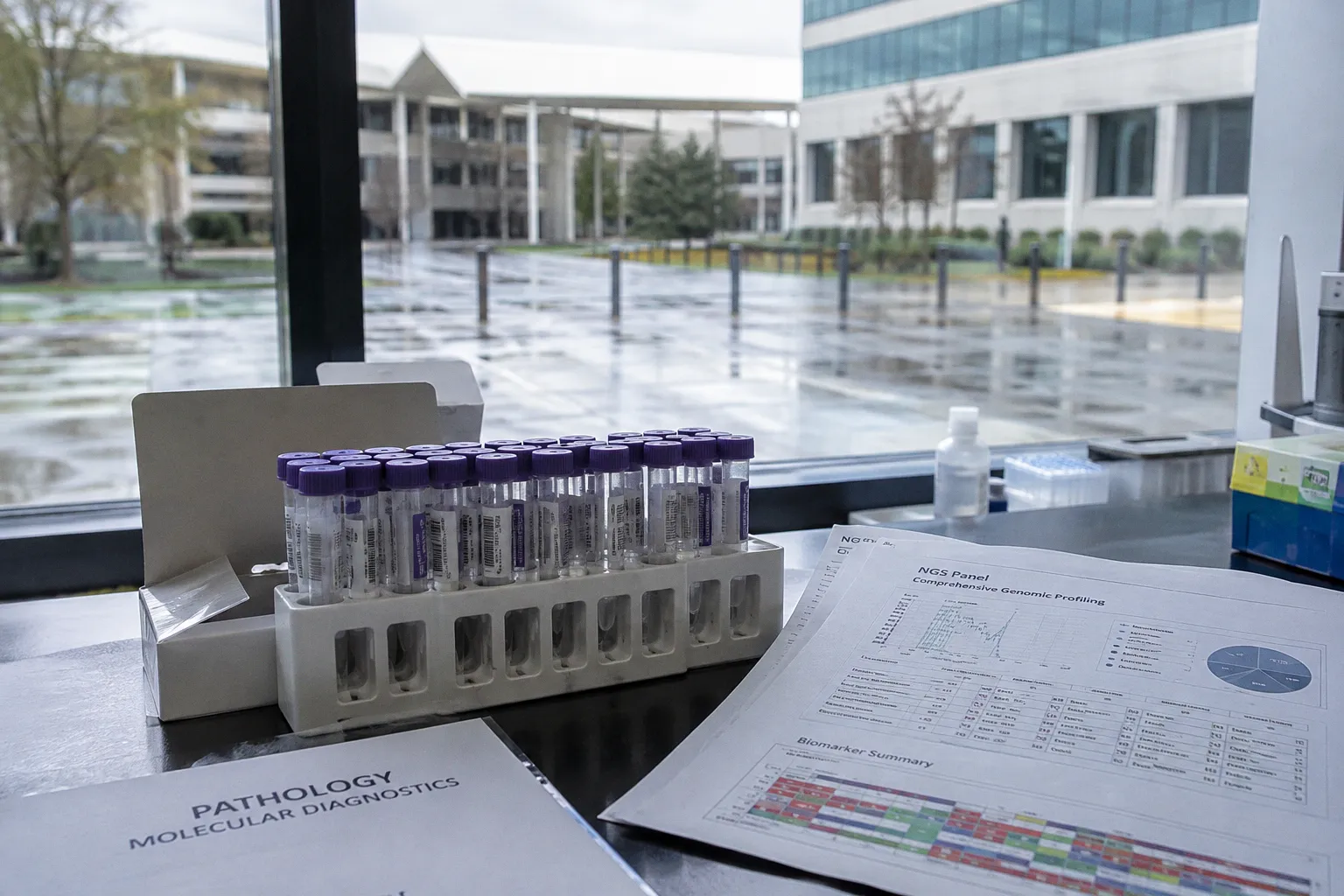
The development is relevant to precision oncology because it places rapid and comprehensive molecular characterization closer to the point at which treatment decisions are made. However, the available evidence describes research presentations and source titles—not a demonstrated change in clinical practice or a validated turnaround-time benchmark.
From genomic data to treatment stratification
The central shift is methodological: rather than relying on a single molecular layer, the reported Caris program integrates genomic and transcriptomic information with clinical data and AI analysis. In principle, this architecture is designed to provide a broader view of tumor biology, immune-related features, and potential treatment-response patterns.
The announced research focuses on thoracic malignancies, including non-small cell lung cancer, small cell lung cancer, and mesothelioma. According to the company’s announcement, the work includes analyses of immunotherapy biomarkers, tumor-microenvironment composition, germline variants, transcriptomic subtypes, and treatment outcomes. These are distinct analytical domains; their inclusion in one research portfolio should not be interpreted as proof that every assay component has equivalent clinical utility.
The evidence also indicates that the findings are being presented at the IASLC 2026 World Conference on Lung Cancer. The program includes seven studies: two mini oral presentations, one poster-tour presentation, and four posters. That format matters for interpretation. Conference presentations can identify clinically relevant signals, but they do not by themselves establish analytical validity, prospective clinical benefit, or regulatory authorization for a specific decision-support use.
What rapid sequencing changes—and what it does not
The broader news cluster includes a Frontiers article on ultra-rapid nanopore sequencing in precision medicine and a Cureus case report describing liquid comprehensive genomic profiling in advanced lung adenocarcinoma complicated by disseminated intravascular coagulation. Together, these titles indicate continued movement toward faster sequencing and liquid-based profiling in difficult oncology settings. The available evidence does not provide validated turnaround times, cohort sizes, performance characteristics, or treatment-outcome estimates for either approach.
For pathology laboratories and oncology services, the operational question is therefore not simply whether sequencing is comprehensive. It is whether the assay can generate clinically interpretable results within the treatment window, from an adequate specimen, with documented quality-control thresholds and a reporting framework that separates actionable findings from exploratory biomarkers.
Patients and clinical clients evaluating such testing should verify which specimen is required, whether the test is tissue-based or liquid-based, which genomic layers are actually included, and whether the report distinguishes validated clinical findings from research-level associations. They should also establish whether germline findings are part of the analysis, since that represents a different clinical and counseling pathway from tumor-only profiling. None of these conditions can be inferred from the current announcements; they are the technical and governance points that determine how a result can be used.
The next evidence threshold
The emerging paradigm is not merely faster sequencing. It is the integration of multiple molecular modalities into a workflow capable of supporting treatment stratification without obscuring assay limitations. The Caris presentations may add data on biomarkers, transcriptomic subtypes, and real-world outcomes, but their clinical impact will depend on the underlying study designs, validation data, reproducibility, and the extent to which findings alter management rather than only refine biological classification.
For laboratories, the near-term signal is a widening gap between sequencing capability and evidence maturity. Comprehensive profiling can expand the biomarker landscape; it does not automatically establish efficacy prediction or therapeutic utility. The decisive next step will be documentation showing which components are analytically validated, which findings are clinically actionable, and how rapidly reliable results can be delivered at the point of care.