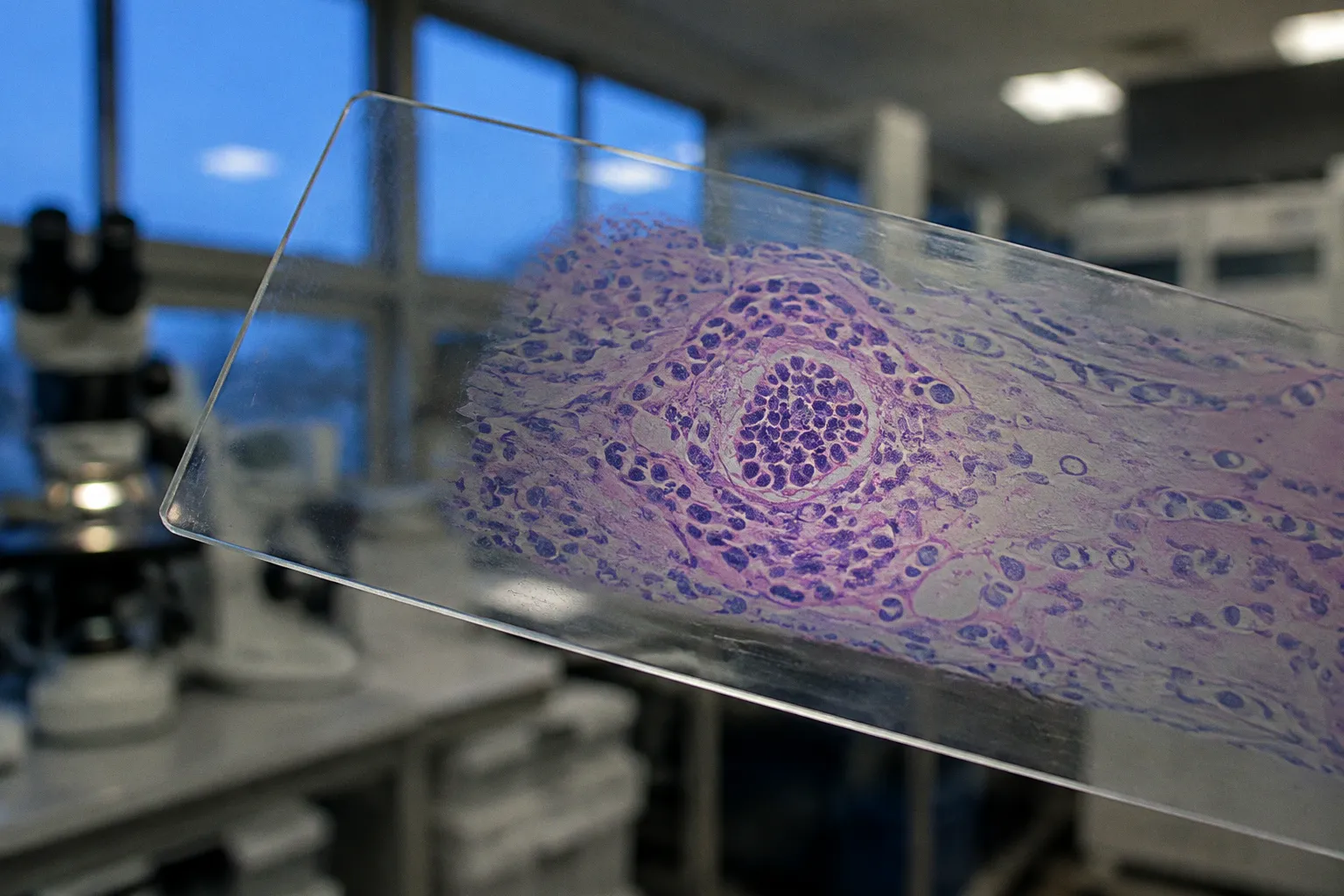
A patient in their late seventies comes in with advanced non-small cell lung cancer. The oncologist orders a liquid biopsy because tissue is scarce and the clock is ticking. Three days later, the report lands: a KRAS G12C variant at a variant allele frequency of 14%, listed as a putative driver mutation, alongside a TP53 alteration that looks pathogenic by every algorithmic filter the lab applied. Everyone in the tumor board leans forward. There is, on paper, an actionable target. And then someone — usually a careful molecular pathologist or a curious technologist — asks the right question: did anyone sequence the white blood cells?
That question is the hinge on which this entire story turns. Because in older adults, a substantial slice of the somatic variants we detect in plasma cell-free DNA are not coming from the tumor at all. They are coming from the patient's own hematopoietic system, where age-related clonal expansion has been quietly rewriting the DNA of white blood cells for years. We call this phenomenon clonal hematopoiesis of indeterminate potential, or CHIP, and when it bleeds into a liquid biopsy, it can mimic a tumor driver with unsettling fidelity. The consequences are not abstract. They reach into treatment decisions, into eligibility for targeted therapy, and into the way we talk to patients about what their disease is doing.
A variant in the blood is not automatically a variant from the tumor. In older patients, the marrow often has its own opinions.
The Biological Overlap: Why CHIP Mimics Tumor Drivers
To understand why this trap exists, you have to understand what CHIP actually is, and the elegance of the problem is what makes it so hard to spot. CHIP is, by the formal clinical definition that the WHO has refined over the years, the presence of a somatic leukemia-associated mutation at a variant allele frequency of at least 2% in blood or bone marrow, in an individual who does not have an overt hematologic malignancy. The word "indeterminate" is doing real work in that phrase — we know the clone is there, we know it carries a mutation that would, in another context, be called pathogenic, but we do not yet know what it is going to do.
Here is where it gets uncomfortable for the molecular diagnostics lab. The same genes that drive CHIP are the same genes that drive solid tumors. DNMT3A alone accounts for roughly half of all CHIP mutations, and TET2 and ASXL1 round out the most frequent trio. But the overlap does not stop there. CHIP variants routinely appear in actionable or oncogenic genes that sit on every solid tumor NGS panel we run: TP53, KRAS, BRCA2, ATM, IDH1, IDH2, and JAK2 are all fair game. These are not obscure findings. These are the exact alterations that prompt reflex testing, drug matching, and clinical trial enrollment.
The mechanism is straightforward enough that I can sketch it from the bench. As people age, hematopoietic stem cells accumulate somatic mutations through the normal wear of DNA replication and environmental exposure. A clone carrying one of these mutations can expand, sometimes substantially, and contribute a meaningful fraction of the nucleated cells circulating in peripheral blood. When we draw blood for a liquid biopsy, we are not just sampling cfDNA shed by the tumor — we are also sampling cfDNA shed by white blood cells, because dying hematopoietic cells release their fragmented DNA into plasma too. The mutations carried by an expanded CHIP clone therefore enter the same tube, the same library prep, and the same bioinformatic pipeline as any tumor-derived signal.
A liquid biopsy cannot, on its own, tell you where a variant came from. It sees sequence and allele frequency. It does not see tissue of origin.
Quantifying the Risk: Age-Related Prevalence and Gene Targets
The numbers tell you why this is not a niche concern. In adults over the age of 65, CHIP prevalence typically falls between 10% and 15%. By age 80, that figure can climb toward 30%. The patient in the tumor board with the KRAS G12C call? Statistically, the prior probability that a detectable clonal hematopoietic mutation is somewhere in their blood is far from trivial.
What complicates the picture further is that not all CHIP mutations are created equal in terms of how convincingly they impersonate tumor drivers. A DNMT3A variant at modest VAF, sitting alongside a clear CT scan, is one thing — the radiologic evidence anchors the diagnosis. But a TP53 mutation detected in cfDNA at an allele frequency that could plausibly come from either the tumor or a hematopoietic clone? That is where the call gets murky, and that is where the report that lands in the clinician's inbox has to be very, very careful about its language.
The other uncomfortable figure in this story is the long-term consequence for the patient themselves. Individuals with CHIP carry approximately a 10-fold increased risk of eventually developing a hematologic malignancy compared to age-matched controls. This does not mean the liquid biopsy finding caused anything — the CHIP was already there — but it does mean that a "false-positive" tumor driver call is sometimes also an early warning about a different disease entirely. The lab that ignores the possibility of CHIP is not just protecting the integrity of one assay; it is potentially obscuring a clinically relevant finding in another organ system.
The Diagnostic Trap: Misinterpreting cfDNA in Solid Tumors
Walk with me through a typical workflow and you can feel where the danger lives. A plasma sample arrives, often shipped on cold packs from a satellite collection site. The lab extracts cfDNA, builds a library, runs the panel — a comprehensive NGS assay covering anywhere from 50 to 300+ genes depending on the institution. The bioinformatics pipeline calls variants against a reference, applies filters for allele frequency, read depth, and population databases like gnomAD, and produces a report.
Now imagine the report flags a JAK2 V617F at 8% VAF in a patient being staged for colorectal cancer. JAK2 V617F is a classic CHIP-associated mutation. It is also a targetable alteration in certain hematologic contexts, and there are emerging trials exploring JAK inhibitors in solid tumors with JAK pathway alterations. The temptation, especially under time pressure, is to list the variant as a putative driver, note the available therapies, and move on. But the variant may have nothing to do with the colon tumor. It may be a passenger event from a hematopoietic clone that has been quietly expanding for a decade.
The variant allele frequency itself offers a weak clue. Tumor-derived ctDNA often tracks with disease burden, and CHIP-derived variants tend to fluctuate with the white blood cell count, but neither of these signals is reliable enough to make a confident call in either direction. I have watched experienced molecular pathologists hesitate over reports where the VAF sits in an ambiguous zone — high enough to be real, low enough to be background, and impossible to localize without the matched control.
This is the diagnostic trap. The pipeline was validated to find variants. It was not designed, on its own, to determine which variants deserve clinical action.
Mitigation Strategies: The Necessity of Matched Buffy Coat Controls
There is a clean technical solution to this problem, and it is one that I wish every liquid biopsy order automatically included. Pair the plasma cfDNA sequencing with matched white blood cell sequencing — typically from the buffy coat fraction of the same blood draw — and you give the bioinformatics team the comparator it needs. Any variant present in both the plasma and the buffy coat at comparable allele frequency can be subtracted from the tumor-derived call list. What remains, after filtering, is a much higher-confidence set of circulating tumor DNA variants.
The logic is elegant in its simplicity. CHIP mutations live in the white blood cells. If you sequence the white blood cells and find the same variant, you have just proven that the plasma signal is, at minimum in part, hematopoietic in origin. If you do not find it in the buffy coat, the variant is far more likely to be tumor-derived — though the converse is not absolute, given the limits of sensitivity and the possibility of subclonal CHIP that falls below the detection threshold of the germline control.
The practical reality, though, is messier than the textbook description. Buffy coat sequencing adds cost, adds turnaround time, and adds a step that some labs have not yet built into their standard operating procedures. It requires a separate extraction, a separate library prep if the panel is run independently, and a coordinated bioinformatics workflow that can handle the comparison without introducing new error modes. For high-volume reference labs running hundreds of liquid biopsies a month, this is not a trivial ask. For hospital labs with constrained budgets and a single molecular technologist on shift, it can feel impossible.
And yet — I keep coming back to the alternative. The alternative is a report that confidently lists a variant as an actionable driver, an oncologist who prescribes a targeted therapy that may not address the actual tumor biology, and a patient who bears the cost and toxicity of a treatment that was never going to work. The matched buffy coat is, in many cases, the difference between a clinically meaningful result and an expensive mistake.
| Workflow Component | Without Buffy Coat Control | With Buffy Coat Control |
|---|---|---|
| CHIP variant filtering | Cannot be distinguished from tumor signal | Variants present in both plasma and WBC are bioinformatically subtracted |
| Actionable call confidence | Moderate to low in older patients | Substantially higher, particularly for genes in the CHIP overlap |
| Turnaround time | Shorter (single sample workflow) | Longer (parallel sequencing and comparison required) |
| Cost per case | Lower | Higher (adds extraction, sequencing, and analysis) |
| Risk of false-positive targeted therapy assignment | Meaningful in patients over 65 | Markedly reduced |
The table does not lie, but it also does not capture the full picture. Labs that have built the matched-control workflow into their pipeline report not just fewer false positives, but better conversations with oncologists — because the reports are more nuanced, the language more precise, and the clinical team has higher trust in the calls that do come through as actionable.
Clinical Implications of Unfiltered Genomic Data
Step back from the bench for a moment and think about what happens at the bedside when CHIP is not filtered out. A patient with advanced disease and limited options receives a report suggesting an actionable alteration. The oncologist reviews the FDA-approved therapies, checks clinical trial enrollment, and may initiate a targeted agent. The patient may experience side effects without therapeutic benefit. The disease may progress on a therapy that was matched to a variant that was never driving the cancer. And somewhere downstream, the case enters a registry or a real-world evidence database as a "treated patient with KRAS G12C," which can subtly distort our understanding of how these drugs actually perform.
There is also the inverse problem, which gets less airtime but matters just as much. A patient whose CHIP mutation is filtered out as background noise may have lost an opportunity for earlier hematologic surveillance. While the clinical management of CHIP itself remains a subject of active investigation — most patients do not require intervention, but the elevated risk of myeloid malignancy is real — there is growing interest in monitoring these clones, particularly when they carry high-risk variants like those in TP53 or splicing factors. A lab that discards the variant without annotation, or filters it so aggressively that the clinical team never sees it, may be silently removing useful information from the chart.
The honest truth is that we are still learning how to handle this at the interface between molecular diagnostics and clinical decision-making. The assays have matured faster than the interpretive frameworks, and that gap is where errors live. What I tell the technologists I mentor, and what I think about whenever I review a liquid biopsy case, is that the variant call is the beginning of the conversation, not the end. Every flagged variant in an older patient deserves the question: where did this come from? And if the answer is "we don't know because we didn't sequence the white blood cells," then the lab has a responsibility to say so on the report, in plain language that the treating team can act on.
The matched buffy coat is not a luxury add-on. For liquid biopsy in any patient over 60, and arguably in younger patients with suggestive findings, it should be considered standard practice. The cost is real, but the cost of an unfiltered actionable call — to the patient, to the clinical team, to the integrity of the precision oncology enterprise — is higher.
The job of the molecular lab is not just to detect variants. It is to protect the patient from acting on variants that were never theirs to treat.