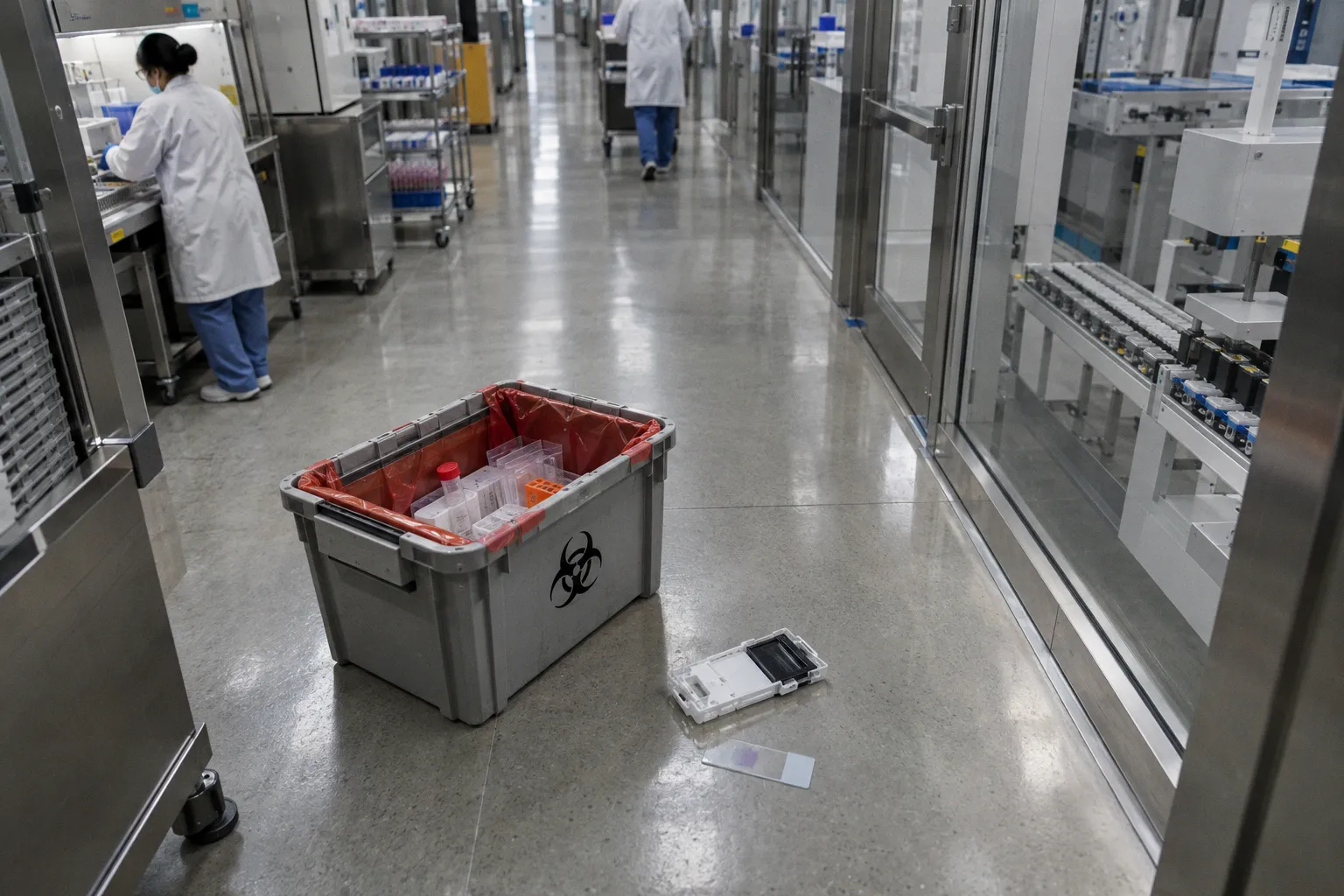
At the MAP Congress 2026, investigators reported that circulating epitranscriptomic profiling combined with machine learning can detect early-stage colorectal cancer and discriminate precancerous lesions from healthy controls, according to data presented via ESMO OncologyPRO. The approach rests on a 5-nucleoside RNA modification signature engineered to circumvent the rapid degradation that has historically constrained blood-based RNA assays and to address the sensitivity deficit that defines stage I liquid biopsies.
An epitranscriptomic answer to stage I sensitivity
The clinical bottleneck for blood-based colorectal cancer screening has not been specificity but stage I sensitivity, where circulating tumor-derived material falls below the detection threshold of conventional ctDNA workflows. The MAP 2026 cohort reframes the analyte: rather than enumerating DNA fragments, the workflow quantifies modified ribonucleosides, a layer of biology that sits upstream of the genome and remains interpretable even when nucleic acid input is sparse. Paired with a machine learning classifier, the five-marker signature appears to resolve precancerous lesions from healthy controls, a distinction that has eluded methylation-based and mutation-based panels. The architectural implication is non-trivial: if validated independently, the platform shifts the screening conversation from "can we find the cancer" to "can we find the lesion before it becomes cancer."
A conserved backbone, divergent edges
In a parallel genomic analysis published in JCO Precision Oncology and summarized by The ASCO Post, Shin and colleagues at Samsung Medical Center sequenced 1,892 patients with histologically confirmed metastatic colorectal cancer between October 2019 and March 2025, using the TruSight Oncology 500 and Oncomine Comprehensive Assay Plus panels. Of these, 376 patients (19.9%) presented before age 50 and 1,516 at average onset, with median ages of 44 and 62, respectively. The driver alteration frequencies were functionally indistinguishable across cohorts: TP53 at 78.5% versus 77.4%, APC at 69.9% versus 70.8%, KRAS at 46.5% versus 48.9%, and BRCA2 at 25.3% versus 24.6%. The investigators concluded that early-onset metastatic colorectal cancer is not a genomically distinct entity; it inherits the same canonical backbone as average-onset disease.
The exceptions, however, are the ones that matter clinically. MYC alterations were enriched in the early-onset cohort (15.7%, P =.012), and within that cohort, age-stratified analyses identified progressive declines in BRCA2, BARD1, FAT1, HIST1H1C, and LRP1B alteration rates with increasing age. High tumor mutational burden was modestly less common in early-onset disease (14.6% versus 19.3%), while high microsatellite instability showed a marginal inversion (2.7% versus 1.7%). These shifts do not redraw the molecular taxonomy of colorectal cancer, but they do sharpen the case for reflex NGS stratification in younger patients, where the underlying driver profile cannot be inferred from age alone.
What pathology laboratories should track
The convergence of these two signals — a pre-genomic analyte for lesion detection and a refined genomic stratification framework for early-onset disease — defines the immediate operational agenda for molecular diagnostics. Laboratories evaluating liquid biopsy platforms should weigh the analytical validation burden of modified-nucleoside assays against their potential to occupy the stage I sensitivity gap, while tumor NGS workflows should anticipate demand for age-anchored reporting that surfaces the MYC and homologous-recombination alterations most relevant to younger patients. Both vectors point toward a stratification-first paradigm in which the assay is selected by the clinical question rather than the specimen type.