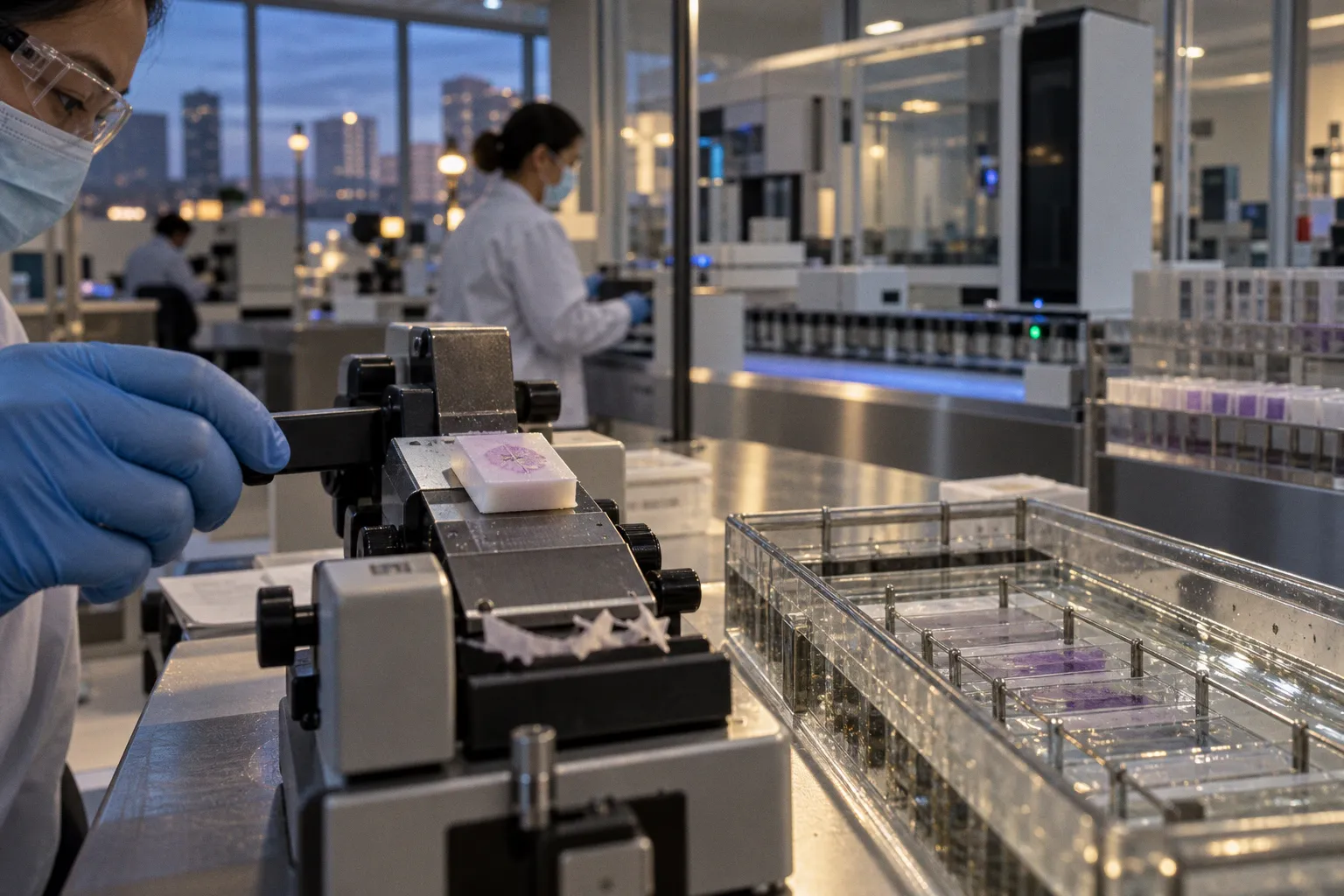
The announcement is anchored by a partnership with the Fraunhofer Institute for Integrated Circuits IIS, formalized to ensure native compatibility between multiplex immunofluorescence imaging data and MIKAIA, MGI's digital pathology analysis software. For molecular diagnostics and surgical pathology laboratories evaluating multiplex tissue imaging workflows, the move packages instrument, reagents, and analysis software within a consolidated vendor stack.
Closing the imaging-to-analysis gap
Multiplex immunofluorescence has become central to tissue-based biomarker characterization across oncology, immunology, and inflammatory disease research, yet laboratories have long wrestled with the friction of moving high-dimensional imaging data from acquisition instruments into downstream computational environments. By integrating the MIKAIA analysis layer, the VisiOmics portfolio addresses that handoff directly: fluorescence acquisition data feeds into the same software environment that handles digital slide review, reducing the need for manual export, format conversion, or third-party analysis tools. The practical effect, if validated in peer-reviewed studies, is a shorter path from raw imaging output to structured analytical results.
Fraunhofer as the interoperability layer
The Fraunhofer IIS collaboration is positioned as the technical bridge, addressing a familiar bottleneck in translational pathology: converting raw multiplex fluorescence output into analysis-ready structured data at scale. Formalizing compatibility between established imaging pipelines and MIKAIA signals an open-architecture posture rather than a closed, instrument-locked platform — a meaningful consideration for laboratories that have already invested in alternative mIF systems and are weighing the cost of migration. The Fraunhofer pedigree also carries procurement weight in European research and reference laboratory environments, where technology transfer credibility frequently determines vendor shortlisting.
What labs should track
ECP 2026 is a launch event, not a clinical evidence milestone. Pathology laboratories considering the platform should monitor forthcoming peer-reviewed analytical validation data, the structure of any reference laboratory partnerships announced in subsequent quarters, and the breadth of intended-use claims MGI pursues as European conformity assessments proceed. Until that evidence package is published, VisiOmics belongs in the translational research toolkit rather than the routine diagnostic workflow — though the distance between the two now appears to be narrowing.