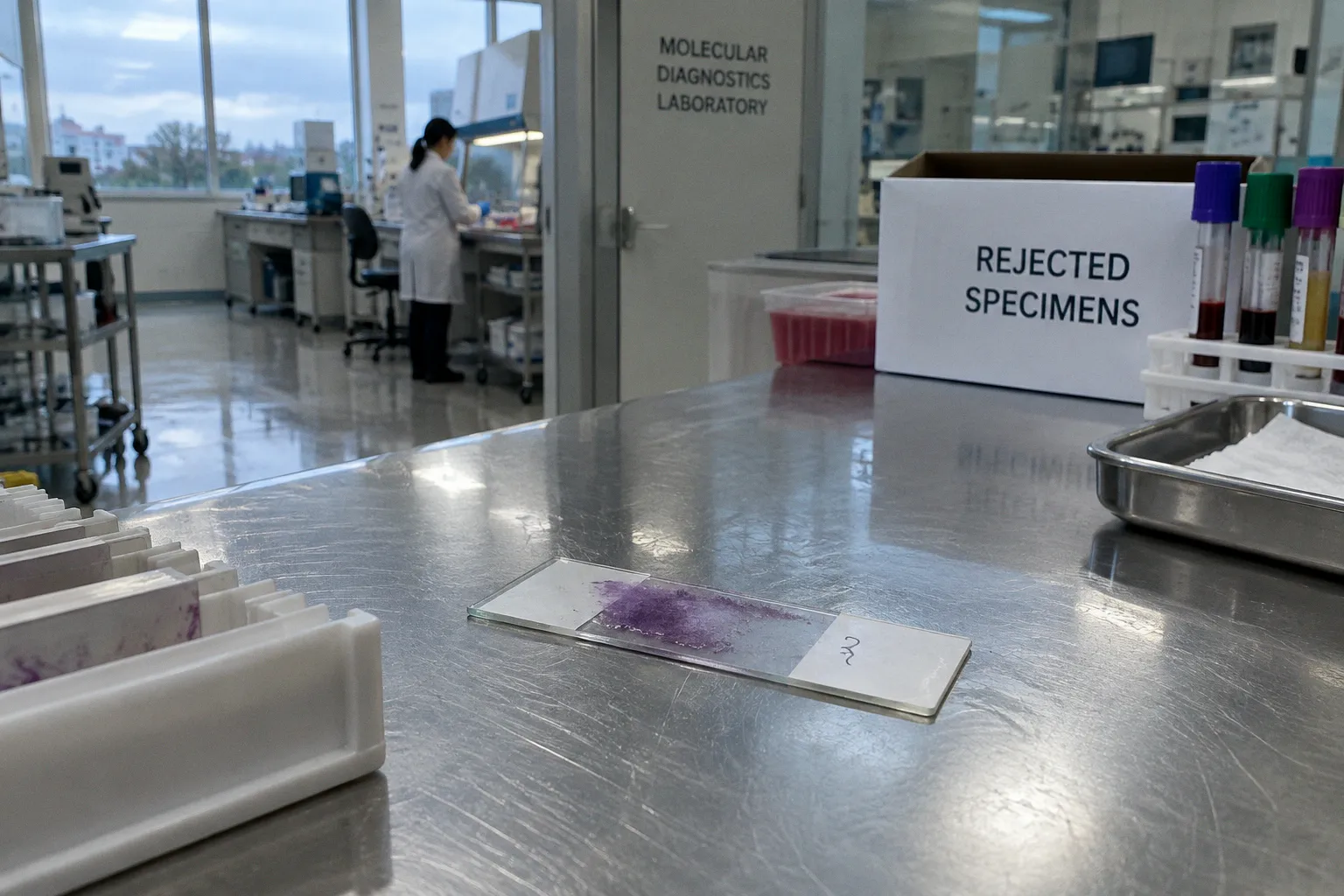
The preanalytical phase—encompassing specimen collection, transport, processing, and storage—is not a preliminary step; it is the foundational determinant of every downstream result. For laboratory directors and administrators, managing this phase is less about quality control and more about strict financial and operational gatekeeping.
Published audits and clinical literature consistently show that between 56% and 70% of all laboratory testing errors occur before analysis even begins. This is not a marginal inefficiency; it is a systemic operational failure with direct impacts on turnaround time, reagent cost, staff morale, and, most critically, patient care. In molecular pathology, where assays are high-value and specimens are often irreplaceable, the rejection decision is a critical control point. A flawed acceptance becomes a catastrophic waste of sequencing capacity and expert review hours.
The Molecular-Specific Rejection Triggers: Beyond Labeling Errors
While universal rejection criteria apply—mislabeled tubes, clotted specimens, leaked containers, and stability limit violations—the molecular laboratory faces a unique set of preanalytical threats that can silently invalidate results.
A specimen that passes visual inspection but carries enzymatic inhibition is worse than a rejected sample. It delivers a false negative with confidence.
PCR Inhibition: The Heparin Problem
Standard chemistry tubes using lithium or sodium heparin anticoagulant are a primary vector for failure in nucleic acid testing. Heparin acts as a potent polymerase chain reaction (PCR) inhibitor, directly interfering with Taq polymerase activity. The correct protocol is non-negotiable: blood for molecular testing must be collected in EDTA tubes. Accepting heparinized blood for a PCR-based assay is an operational error, not a quality event.
Fixation Artifacts in FFPE Tissue
Formalin fixation, the gold standard for tissue preservation, is also the source of profound nucleic acid damage. It causes cytosine deamination, leading to C-to-T transition artifacts that mimic real low-frequency variants in next-generation sequencing (NGS) data. Furthermore, it fragments DNA and creates crosslinks. The laboratory’s rejection criteria must extend to fixation parameters—duration, concentration, and tissue-to-formalin ratios—before the block is ever submitted for testing.
Standardizing Acceptance Protocols: The Compliance Framework
Informal judgment calls invite inconsistency and liability. Acceptance and rejection criteria must be codified in the laboratory’s standard operating procedures (SOPs) under a clear regulatory framework.
The Regulatory Triad: CLIA, CAP, and ISO 15189
Compliance with Clinical Laboratory Improvement Amendments (CLIA), College of American Pathologists (CAP) accreditation standards, and the international ISO 15189:2022 is not optional; it is the license to operate. These frameworks mandate:
- Documented Criteria: Clear, written sample acceptance and rejection policies.
- Logged Rejections: Every rejected specimen must be logged with the reason, and the ordering provider notified.
- Clinical Impact Assessment: Before discarding, the laboratory must evaluate the clinical consequence of non-testing, especially for non-recollectable samples.
This triad forms the operational spine of specimen management. The SOPs should leave no room for interpretation; they must specify tube types, stability windows, volume requirements (e.g., <90% fill in coagulation tubes triggers rejection), and the mandatory identifiers required on every container.
Managing Precious Specimens: The Exception Handling Protocol
Not all specimens are created equal. A cerebrospinal fluid (CSF) sample, a core biopsy from a pediatric patient, or a bone marrow aspirate represents a unique clinical moment. These are non-recollectable and high-value. The standard rejection flow does not apply.
Protocol for Irreplaceable Samples
1. Immediate Triage and Identification: The accessioning team must immediately flag precious specimens in the Laboratory Information System (LIS). A "special handling" or "irreplaceable" status triggers a distinct workflow.
2. Escalated Authorization: Rejection of a precious specimen is not a bench-level decision. It requires immediate communication to a laboratory director or designated supervisor for final authorization.
3. Analytical Disclaimers and Documentation: If the decision is made to proceed with a suboptimal specimen, the process must be documented. This includes:
- Recording the specific flaw (e.g., short draw, wrong tube).
- Obtaining and documenting director-level authorization to test.
- Attaching a clear disclaimer to the final report stating the limitation and its potential impact on result accuracy and reliability.
This protocol turns a potential catastrophe into a managed risk with full traceability.
Quality Metrics for NGS Readiness: Thresholds for Action
For next-generation sequencing, preanalytical quality is quantifiable. Two key metrics determine whether a formalin-fixed, paraffin-embedded (FFPE) sample is viable for downstream sequencing.
The DIN and Concentration Gatekeeper
The DNA Integrity Number (DIN), provided by electrophoresis systems, quantifies the extent of DNA fragmentation. The operational threshold is clear:
- DIN ≥ 2.1 and DNA Concentration > 10 ng/µL: This combined benchmark predicts sequencing library success in over 90% of clinical FFPE samples.
- Below Threshold: Samples falling below this gate require a director’s review. Options include: accepting the risk with a report disclaimer, attempting repair-based library preps (increasing cost), or rejecting the sample.
Implementing these thresholds transforms subjective "DNA quality" assessments into a binary, actionable decision matrix.
Operationalizing Rejection: The Bottom Line
A specimen rejection is a failure of the preanalytical process, not a success of quality control. The goal is to minimize the rejection rate by enforcing strict, clear criteria upstream with collectors, couriers, and processing staff. Every rejection logged is a data point for root cause analysis: is it a training issue with a specific clinic? A transport time problem with a courier route? A stability window that is too narrow?
The laboratory manager’s role is to use rejection data to drive process improvement, not merely to enforce it. The financial and clinical cost of a single rejected irreplaceable specimen far exceeds the cost of a rigorous preanalytical compliance program. In molecular diagnostics, the assay begins the moment the specimen is collected. Managing that moment is the first and most critical line of defense.