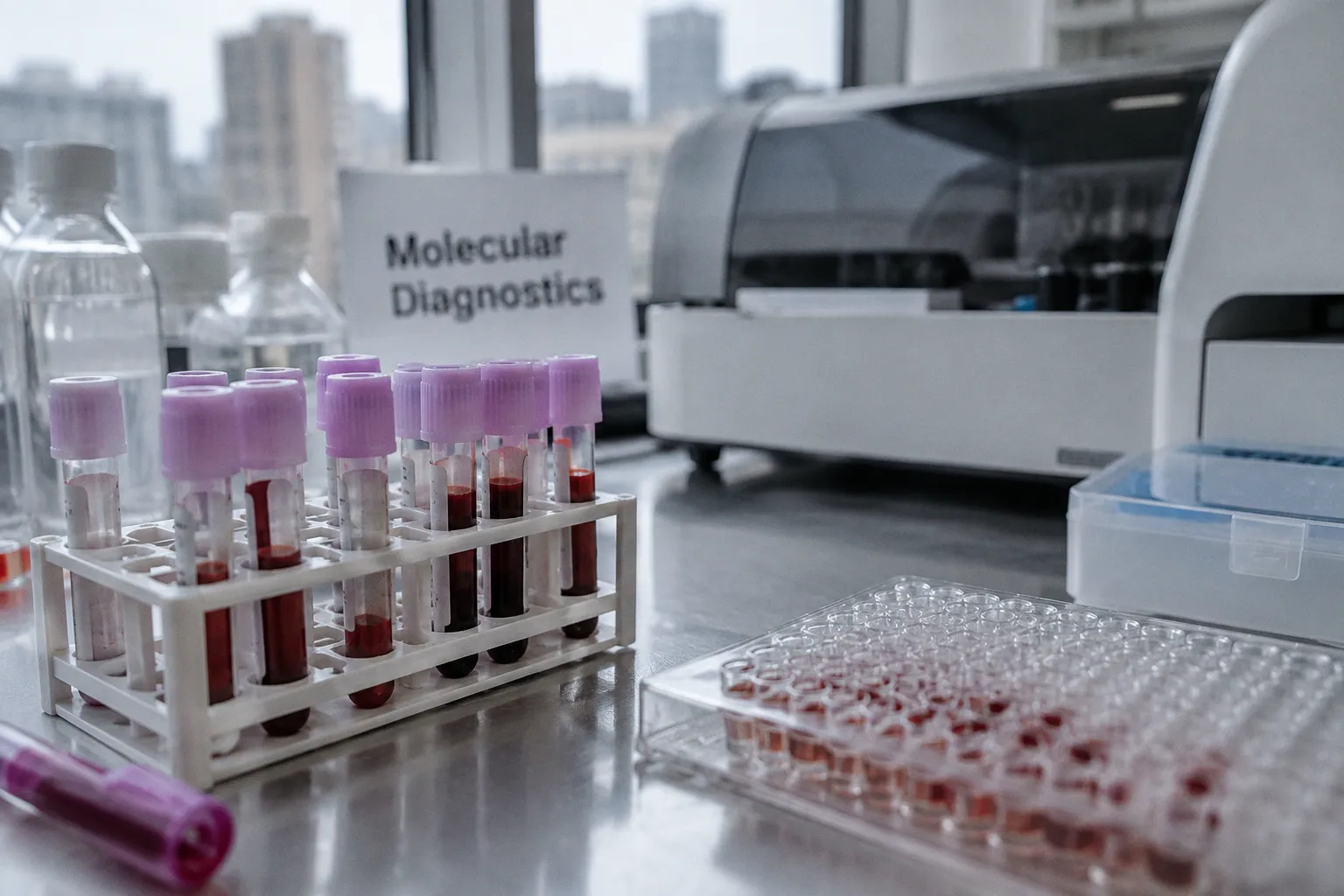
The source argues that decentralization, deeper molecular testing, and software-based interpretation are converging, with consequences for how hospitals, clinics, and laboratories evaluate diagnostic infrastructure. For clinical pathology, the relevant issue is not simply instrument replacement: it is where testing occurs, which assays remain available, and how diagnostic output enters the care pathway.
The value proposition is moving beyond test volume
The analysis describes a reversal of the traditional sequence in which clinicians decide on a treatment pathway and diagnostics subsequently confirm or refine that decision. Its central thesis is that testing increasingly influences therapeutic selection and reimbursement-related decisions at an earlier stage.
That shift has direct implications for laboratory procurement. Organizations that continue to evaluate diagnostics primarily as a commodity input may be using an outdated model, particularly as molecular depth and software-driven interpretation become more prominent. The source characterizes the current transition as a reallocation of diagnostic value rather than a routine cycle of incremental instrument upgrades.
For pathology and molecular laboratories, this means that analytical performance remains necessary but is no longer the only differentiator. Assay availability, interpretation capacity, workflow integration, and the location of testing increasingly determine whether a platform can support precision-medicine pathways.
Decentralization is becoming a competitive variable
The report presents centralized laboratory testing as durable but no longer dominant in every clinically decisive moment. Testing activity is described as dispersing toward pharmacies, clinics, and homes, with portable and easy-to-operate platforms positioned to serve settings that centralized reference laboratories cannot reach as efficiently.
The source does not establish a quantified migration of testing volume, and its claims should therefore be treated as a market thesis rather than a validated forecast. It does, however, identify a clear strategic question for laboratory directors: which categories of testing are most likely to move closer to the patient, and what level of molecular complexity can those decentralized workflows reliably support?
The analysis also argues that point-of-care testing will not merely complement central laboratories, but may absorb a defined share of higher-value work. That proposition requires careful scrutiny at the implementation level. A near-patient platform must be assessed not only on speed and portability, but also on assay menu, specimen handling, interpretation, quality controls, connectivity, and the conditions under which results can be incorporated into a clinical decision.
Assay menus may matter more than hardware
A further conclusion in the source is that the durable economics of the IVD market may sit less in instrument sales than in reagents, consumables, and service contracts. It also identifies assay menus as a potential driver of consolidation, suggesting that smaller companies with differentiated molecular or near-patient capabilities could attract strategic interest even without scale in conventional hardware markets.
For laboratories evaluating a vendor, the practical diligence therefore extends beyond analyzer specifications. The critical documents and conditions to examine include the available assay menu, the intended testing setting, reagent and consumable dependencies, software interpretation functions, service obligations, and the pathway for expanding or changing menu coverage. These factors determine whether a platform can support a stable diagnostic workflow rather than merely perform an isolated test.
The market direction remains a thesis reported by an unverified source, not a demonstrated clinical or regulatory outcome. Its strongest implication is nevertheless concrete: procurement decisions in molecular diagnostics are increasingly likely to be judged by their effect on care pathways, patient proximity, and assay-led workflow control. Central laboratories are not disappearing, but the competitive boundary around where diagnostic value is created is moving.