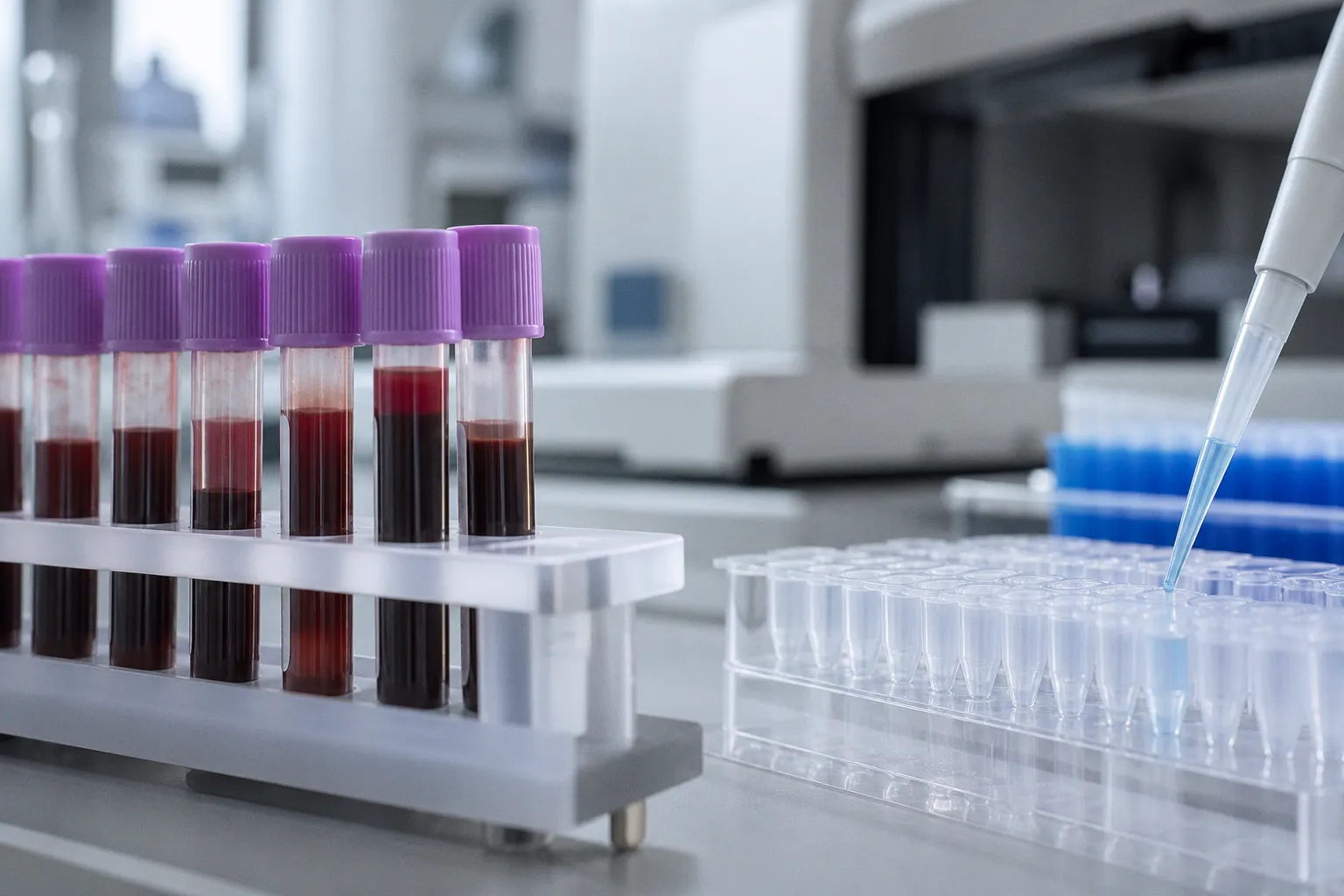
According to the U.S. Food and Drug Administration, camizestrant-based treatment received accelerated approval for advanced HR-positive, HER2-negative breast cancer when an ESR1 mutation is detected in circulating tumor DNA. The agency also authorized Guardant360 CDx as the companion diagnostic used to identify eligible patients. For molecular pathology services, the decision reinforces a central clinical principle: treatment access is now directly linked to a defined genomic finding and the diagnostic system used to establish it.
ESR1 status becomes the treatment gate
Eligibility is not described simply by tumor subtype; it depends on detection of an ESR1 mutation, with Guardant360 CDx designated as the companion diagnostic for that purpose.
That distinction is operationally important for oncology laboratories and clinical teams. A companion diagnostic is not an incidental biomarker panel added after treatment selection. In this case, the assay is tied to identifying patients for whom the camizestrant-based approach may be considered under the accelerated approval.
The available announcement does not provide analytical-performance metrics, mutation-level reporting requirements, turnaround-time targets, or comparative data for alternative ESR1 testing strategies. Those omissions matter when laboratories assess whether their current molecular workflow can support the new treatment pathway without introducing ambiguity at the point of clinical decision-making.
What laboratories and clinics should verify
The immediate question for providers is not whether ESR1 testing is generally relevant to breast cancer, but whether the diagnostic process being used corresponds to the FDA-authorized companion-diagnostic framework. Clinical services will need to establish which test is being ordered, what specimen type is accepted within that workflow, and how a positive ESR1 result is documented for treatment review. The supplied FDA summary confirms circulating tumor DNA and Guardant360 CDx, but it does not provide the additional operational specifications.
The same restraint applies to interpretation. The evidence identifies detection of ESR1 mutations as the condition associated with the accelerated approval, but it does not enumerate individual variants, define borderline findings, or describe how discordant results should be adjudicated. Those details should therefore be obtained from the applicable assay documentation and treatment protocols rather than inferred from the authorization headline.
For pathology and laboratory leaders, the regulatory significance is clear even before those implementation details are published in the available material: the diagnostic result has become part of the therapeutic eligibility architecture, not merely a supplementary molecular annotation.
The wider companion-diagnostic trajectory
The FDA authorization arrives as other diagnostic developers expand biomarker quantification and stratification technologies. Pathology News reports that AIVIS is extending its AI-powered Qanti platform into antibody-drug conjugate development, including patient stratification and companion-diagnostic research, using quantitative cell-level immunohistochemistry analysis.
That development concerns a different technology and development context, but it points toward the same structural shift: oncology treatment selection is increasingly organized around measurable biomarkers, with diagnostic platforms positioned as decision infrastructure. The Guardant360 CDx authorization represents the more immediate regulatory milestone because the FDA has explicitly linked the assay to identifying patients for an accelerated-approved treatment approach.
The next material checkpoint will be the quality of implementation: how clearly ESR1 results are generated, reported, and connected to clinical eligibility. In precision oncology, the therapeutic paradigm is only as reliable as the biomarker pathway that activates it.