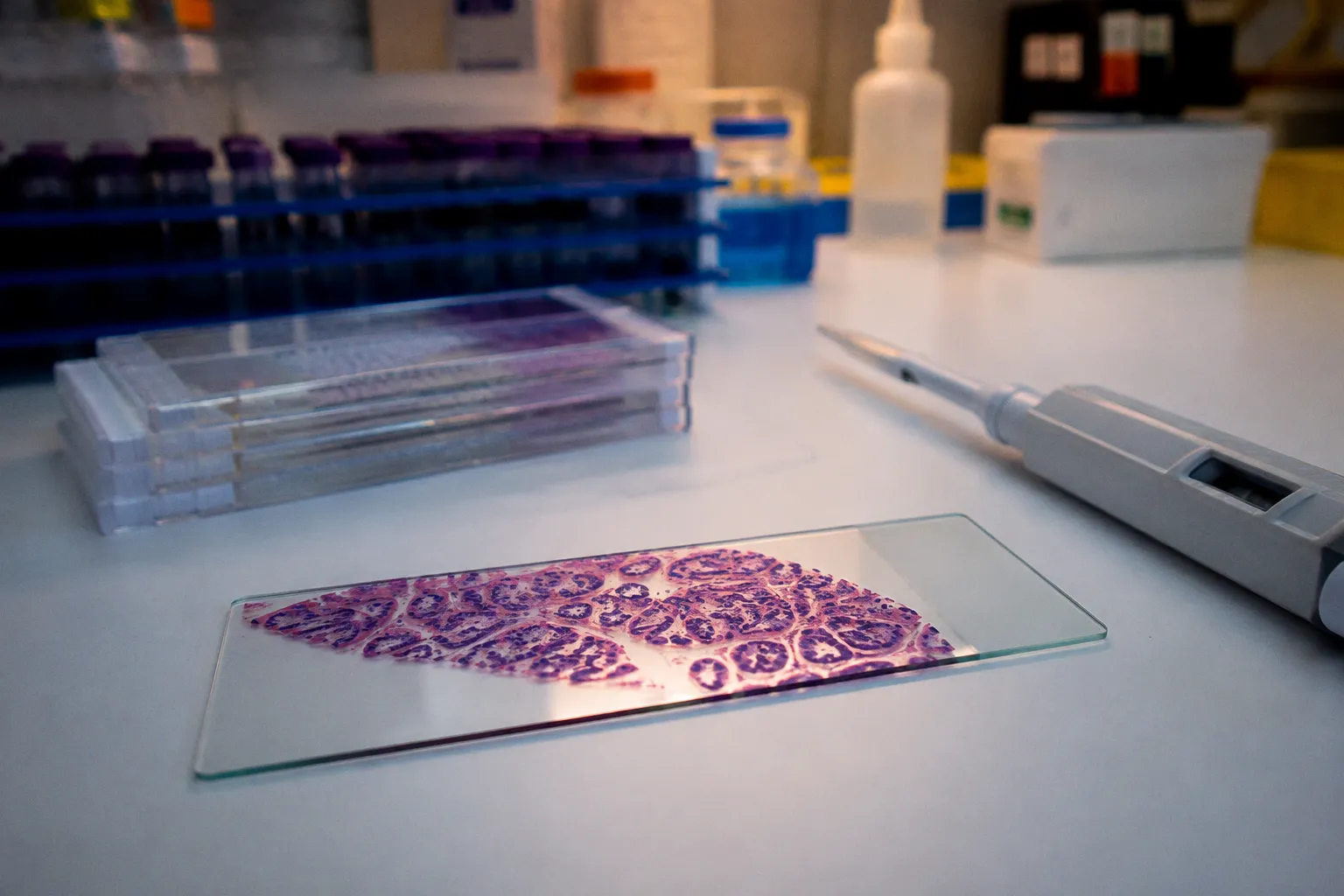
Across 20 independent HRD assays benchmarked against the same tumor samples in the Friends of Cancer Research HRD Harmonization Project, median pairwise positive percent agreement was 74% (IQR 51–89%) on in silico samples and 83% (IQR 70–91%) on clinical ovarian cancer samples. Negative percent agreement sat at 81% and 80% respectively. Two vendors, given the same DNA, can return opposite HRD classifications. For a laboratory director who has already committed validation budget, staff hours, and a CLIA-validated workflow to a single platform, that residual disagreement is an operational liability — and a margin question. The assay that cleared validation last year may be misclassifying patients today in ways the literature has only recently begun to document.
Two vendors, given the same DNA, can return opposite HRD classifications. For a laboratory director, that residual disagreement is an operational liability — and a margin question.
The Mechanics of Genomic Scars: LOH, TAI, and LST
The HRD assay landscape splits into at least two broad measurement architectures, and conflating them is the first procurement error. The Myriad myChoice HRD CDx — the FDA-approved reference standard for ovarian cancer — scores tumors across three categories of genomic scar: Loss of Heterozygosity (LOH), Telomeric Allelic Imbalance (TAI), and Large-scale State Transitions (LST). Each scar type captures a different facet of DNA repair failure. LOH reflects copy-number–neutral loss of allelic diversity across autosomes, a footprint of replication without an intact homologous repair template. TAI tracks allelic imbalance that extends to the telomere, a signature of breakage-fusion-bridge cycles initiated by dysfunctional repair. LST records large-scale chromosomal breaks between adjacent regions, marking the catastrophic rearrangements that accompany sustained HR deficiency.
But myChoice is not the only architecture on the market. FoundationOne CDx and other comprehensive genomic profiling platforms approximate HRD through HRR gene sequencing — cataloguing pathogenic variants in homologous recombination pathway genes such as BRCA1, BRCA2, RAD51C, RAD51D, PALB2, and others — combined with an LOH-only genomic instability metric. Some laboratory-developed tests pair gene-panel sequencing with alternative instability indices derived from different scar subsets or proprietary weighting schemes. The result is a marketplace where the label "HRD assay" describes at least three distinct measurement strategies, each producing a score that reflects its own definition of genomic instability.
This matters operationally because the three scar types in the myChoice framework do not move in lockstep. A tumor can be LOH-rich but LST-quiet, or LST-heavy but TAI-balanced. When an assay sums them under proprietary weights, the result is a composite that cannot be reverse-engineered from the raw BAM file. When a different assay relies on gene-level calls plus LOH alone, the score captures a fundamentally different slice of the same tumor's biology. Two laboratories running the same tissue through two validated assays are not measuring the same property twice. They are running two distinct tests.
Quantifying Discordance: Insights from the Harmonization Project
The Friends of Cancer Research HRD Harmonization Project remains the most ambitious benchmarking exercise the field has produced. Twenty independent assays. 348 in silico tumor samples. 90 clinical ovarian cancer samples. A single harmonized reference standard. The headline finding is not the median — the median is the optimistic number. The IQR is the procurement story. For in silico samples, the interquartile range of pairwise positive percent agreement stretched from 51% to 89%. A pair of assays at the 25th percentile agrees barely better than a coin flip — 51% PPA, a single percentage point above chance. A pair at the 75th percentile agrees nine times out of ten. Both pairs are commercially available. Both pairs are likely in use at sites within the same referral network.
| Sample cohort | Median PPA | IQR PPA | Median NPA | IQR NPA |
|---|---|---|---|---|
| In silico (n=348) | 74% | 51–89% | 81% | 64–92% |
| Clinical ovarian (n=90) | 83% | 70–91% | 80% | 62–91% |
For a laboratory director, the takeaway is operational, not scientific. Concordance is not a property of the tumor; it is a property of the assay pair. The same tissue classified HRD-positive by assay A and HRD-negative by assay B is not a biological edge case — it is the IQR. Validation against a single vendor's reference standard, however rigorous, does not transfer to patients run on the next vendor's platform.
The Threshold Problem: Why Scores Between 35 and 49 Create Clinical Ambiguity
Every HRD assay in clinical use today runs on a cutoff. Myriad myChoice returns GIS ≥ 42 as HRD-positive; the academic literature uses 35, 38, and 42 interchangeably; laboratory-developed tests set their own. The 35–49 band is where the diagnostic classification becomes fragile — not because the biology is uncertain, but because the assays disagree most precisely here.
The 35–49 band is where classification becomes fragile. Not because the biology is uncertain — because the assays disagree most precisely there.
Consider a concrete scenario. A tumor returns a GIS of 42 on the myChoice assay — one integer above the positivity threshold, an HRD-positive result. Run the same tumor on an alternative assay with different scar weighting or a different cutoff, and the score may land below that platform's threshold. A result that is unambiguously positive on one platform can be negative, equivocal, or clinically uninterpretable on another. The clinical report that goes to the tumor board carries the certainty of a binary result. Underneath it sits a continuous score whose categorical interpretation is entirely assay-dependent.
Operationally, this creates three downstream problems:
- A patient eligible for PARP inhibitor therapy at a center running assay A may be ineligible at a center running assay B. Treatment access becomes platform-dependent — an outcome no clinical guideline intended.
- Reflex testing — sending borderline samples to a second vendor — adds time and cost to the diagnostic workflow. Whether the ordering institution can absorb that delay, and whether a second invoice is reimbursable, are operational questions that rarely have a pre-built answer.
- Internal quality-control programs that monitor assay drift have no external gold standard. The laboratory is monitoring its own output against its own baseline, which by construction cannot detect systematic misclassification of borderline cases.
Beyond BRCA: Limitations of Genomic Instability as a Proxy for HR Function
Approximately 50% of high-grade serous ovarian cancers exhibit HRD. Only roughly 21% carry germline or somatic BRCA1/2 loss-of-function mutations. The remaining population — close to one in three high-grade serous ovarian tumors — is HRD-positive by genomic scar analysis without an identifiable BRCA driver. Genomic instability testing exists to capture exactly this cohort. But a genomic scar is a historical record of past DNA damage, not a measurement of current homologous recombination functional capacity. A tumor that was HRD-deficient at the time of scar formation may have restored function through secondary reversion mutations, promoter demethylation, or other compensatory mechanisms. A tumor with a clean BRCA profile may carry pathogenic variants in other HRR pathway genes — RAD51C, RAD51D, PALB2, RAD51B, or others — that leave the same scar pattern but are invisible to assays that score only LOH or only BRCA status.
This distinction between historical scar and current function is not academic. PARP inhibitor response depends on present-tense repair deficiency, not on a genomic receipt from six months ago. The scar-based assay cannot distinguish a tumor that is still HR-deficient from one that has recovered — it can only report that the instability happened. For the laboratory, the implication is reportable language. A positive HRD result is not a functional readout. It is a probability statement about PARP inhibitor susceptibility grounded in a population-level association. The downstream clinician needs to read it that way.
A laboratory that returns "HRD-POSITIVE" without contextual annotation is overstating the science. A laboratory that returns "GIS = 47, myChoice CDx, HRD-positive per cutoff ≥ 42" is reporting what was actually measured. The difference is not semantic. It is the difference between a report that survives peer scrutiny and one that does not.
Interpreting False-Positive Rates in Alternative Diagnostic Platforms
Concordance studies comparing alternative assays to the Myriad myChoice HRD CDx routinely report high overall agreement — but overall agreement masks the metric that determines clinical consequence. The false-positive rate against the reference is the number that decides whether a patient who should receive a PARP inhibitor actually does, and whether a patient who should not is exposed to a drug with documented hematologic toxicity.
| Alternative assay | False-positive rate vs. myChoice GI status |
|---|---|
| AmoyDx GI status | 31.6% |
| OncoScan | 31.9% |
A false-positive rate near 32% does not mean the assay fails 32% of the time in a global sense. It means that, among samples classified HRD-positive by the alternative platform, nearly one in three is HRD-negative by the myChoice reference standard. Translated into clinical operations: a laboratory running the AmoyDx platform will refer a meaningful fraction of HRD-positive patients to PARP inhibitor therapy who would be classified HRD-negative — and therefore ineligible — under the FDA-approved companion diagnostic. Whether that trade-off is acceptable depends on the clinical context, the tumor type, and the treatment landscape. Whether the ordering oncologist understands the discrepancy is a laboratory question. The report the laboratory issues is the only document the tumor board has. If the report does not name the platform, the cutoff, and the reference standard, the tumor board is reading a result without context.
What the Laboratory Director Owes the Tumor Board
Three operational decisions are non-optional for any laboratory issuing HRD results:
- Declare the platform on every report. Not the vendor name alone — the assay version, the cutoff applied, and the FDA approval status of the specific indication. A result from a laboratory-developed test is not interchangeable with a result from an FDA-approved companion diagnostic, even when both carry the label "HRD-positive."
- Build a borderline protocol before the first borderline sample arrives. Scores in the 35–49 band require a documented reflex pathway: send-out to a second platform, pathologist adjudication, or formal acknowledgment that the classification is assay-dependent and the clinical decision rests with the oncologist.
- Audit false-positive rates against published references, not against internal QC alone. A laboratory that has not benchmarked its assay against the myChoice CDx or against the Friends of Cancer Research harmonization data is operating without an external comparator. Internal QC monitors precision. It does not monitor accuracy.
The HRD companion-diagnostic market will not standardize on a single algorithm in the foreseeable future. The proprietary weighting behind myChoice remains unpublished; laboratory-developed tests proliferate; reference-grade alternatives continue to enter the market with their own cutoffs and their own validation packages. For the laboratory director, the strategic question is not which assay is right. It is whether the laboratory's reporting, reflex, and audit infrastructure are built for a market where two valid assays can return two valid answers on the same tumor. If the answer is no, the margin erosion is already in motion — waiting for the next borderline sample to make it visible.